
Published September 30, 2026
A roofing website should help qualify local leads before it tries to impress. When comparing roofing company website design Seattle providers, look beyond polished visuals. Can a homeowner quickly understand what you do, where you work, and how to request an estimate? If those answers are hard to find, the site may attract attention without making the next step clear.
A professional appearance matters, but a generic template can blur the differences between repairs, replacements, and other work. And if a proposal leaves out support or site structure, you may be unsure what youâre actually buying.
This guide shows you how to compare designers and proposals. Youâll learn what to check on mobile, which deliverables and support questions to raise, and how an SEO-ready structure can support useful Seattle-area service pages. Use the checklist to spot gaps and choose a practical next step for your business.
Key Takeaways
- Judge a website by how clearly it explains your roofing services and helps the right visitors take a next step.
- Use this roofing company website design Seattle guide to compare mobile usability, page structure, content responsibilities, hosting, and support.
- Look for authentic, current trust signals. Photos, project examples, reviews, and certifications each have limits.
- Compare proposals by specific deliverables, ownership, communication, and ongoing support, not by a vague promise of a better website.
- Prepare accurate service details, coverage areas, approved images, and contact preferences to keep the project focused.
Table of Contents
- What Seattle Roofing Companies Need From a Business Website
- Roofing Company Website Design Features to Evaluate Before You Hire
- Compare Roofing Website Designs by How Well They Earn Trust
- A Seattle Roofing Website Design Checklist for Comparing Proposals
- Choose a Roofing Company Website Design Partner and Plan the Launch
What Seattle Roofing Companies Need From a Business Website
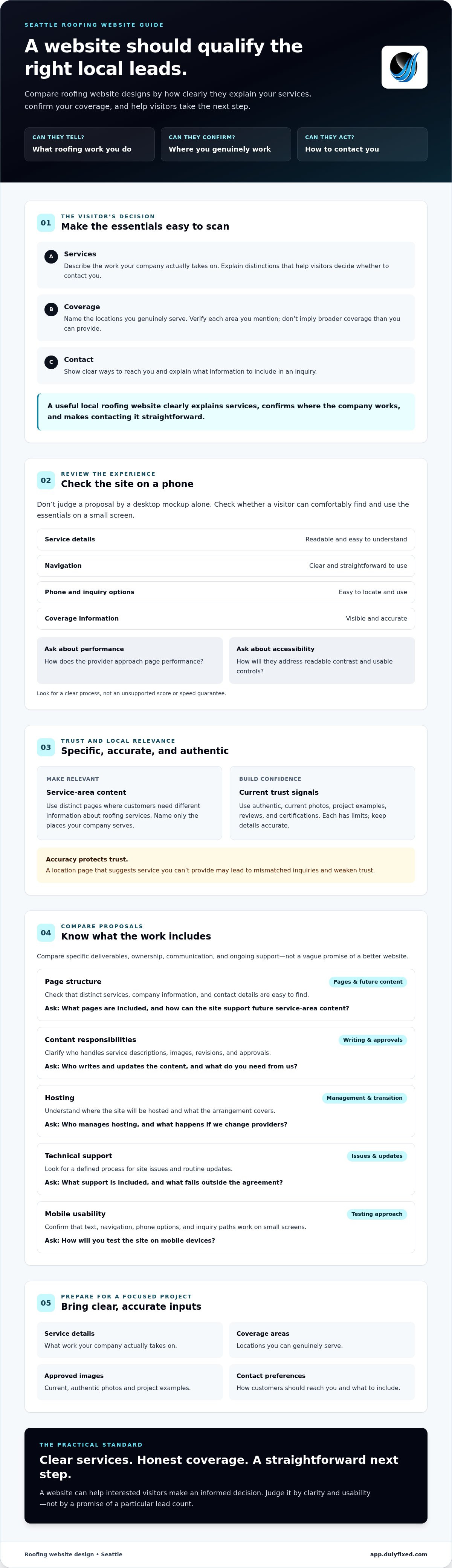
Start with the visitorâs decision: Can they quickly understand what your company does, whether you serve their location, and how to contact you? Thatâs the practical test for roofing company website design Seattle. A polished look helps, but it canât make up for unclear services or a hard-to-find phone number.
Your website works alongside referrals, search, and other marketing. It gives people a place to check details after hearing about your company or finding it online. Good elements of web design bring content, usability, and search considerations together. The goal isnât to replace other ways customers find you. Itâs to help interested visitors make an informed decision.
How homeowners use a roofing company website
A prospective customer may want to confirm whether you handle roof repairs, replacements, inspections, or other work. They may also need to know whether you serve their area and whether calling or requesting an estimate is the right next step. If those answers are difficult to find, visitors have to guess or keep researching.
Make the essentials easy to scan:
- Services: Describe the work your company actually takes on. Explain distinctions that help a visitor determine whether to contact you.
- Coverage: Name the locations you genuinely serve. Donât imply broader coverage than you can provide.
- Contact: Show clear ways to reach you and explain what information to include in an inquiry.
Concise answers help visitors decide whether to call, request an estimate, or compare other options. The goal isnât simply more traffic. Itâs an inquiry from someone who understands the service, coverage, and next step. A website canât promise a particular lead count.
What makes a local roofing website feel relevant
Local relevance starts with accuracy, not a long list of place names. Describe the work you actually do and name the areas you genuinely serve. If you mention Seattle neighborhoods, verify that your company covers each one. A location page that suggests service you canât provide may lead to mismatched inquiries and weaken trust.
A useful local roofing website clearly explains a companyâs services, confirms where it works, and makes contacting it straightforward. Keep that standard in mind as you review your current site or compare proposals. The next sections cover design and support features that help you meet and maintain it.
Roofing Company Website Design Features to Evaluate Before You Hire
A strong proposal explains how the site will help visitors understand your services and contact you. For roofing company website design Seattle, compare the working parts of the site, not just a visual mockup. Ask who handles content, what hosting includes, and how support works after launch. A providerâs website and landing page services overview can help you understand its scope.
| Feature | What to evaluate | Ask the provider |
|---|---|---|
| Mobile usability | Readable text, clear navigation, and easy-to-use phone and inquiry options on small screens. | How will you test the site on mobile devices? |
| Page structure | Pages that make distinct services, company information, and contact details easy to find. | What pages are included, and how can the site support future service-area content? |
| Content responsibilities | A clear division of work for service descriptions, images, revisions, and approvals. | Who writes and updates the content, and what do you need from us? |
| Hosting | Clarity about where the site will be hosted and what the arrangement covers. | Who manages hosting, and what happens if we change providers? |
| Technical support | A defined process for help with site issues and routine updates. | What support is included, and what falls outside the agreement? |
Mobile-first design, speed, and accessibility
Review the proposed site on a phone, not only in a desktop presentation. Check whether service details are readable, navigation is easy to use, and the phone number, contact form, and coverage information are easy to locate. Ask the designer how they approach page performance and accessibility, including readable contrast and usable controls. Look for a clear process rather than an unsupported score or speed guarantee.
Service pages, local relevance, and search foundations
Distinct roofing services may need separate pages when customers require different information to understand the work. For example, a repair page should explain that service instead of repeating replacement copy under a new heading. Ask how Seattle-area content will reflect your actual coverage and provide useful details, rather than near-identical pages for every location. For broader business planning, SBA's business guide includes information on marketing and sales that can help connect website messaging to business goals.
An SEO-ready structure helps search engines understand how your pages relate and gives you a sensible foundation for future content. It doesnât guarantee rankings. Ask what page structure, editable content, and technical support are included. To discuss how a websiteâs scope could fit your business, contact Dulyfixed about website planning.
Compare Roofing Website Designs by How Well They Earn Trust
A polished design can make a strong first impression, but clarity builds confidence. With roofing company website design Seattle, visitors should be able to tell what work the company handles, where it works, and how to ask a question. Photos and badges may support that message, but they canât replace accurate service details or a clear way to get in touch.
The right format depends on your needs. A template may be a practical starting point. A custom site may suit a broader range of services and content. A focused landing page can support one specific offer or campaign. None is automatically the best choice.
| Format | Strength | Consideration |
|---|---|---|
| Template site | Uses an established layout that can make common information easy to organize. | Check whether the design can present your services clearly without feeling generic. |
| Custom-designed site | Can be shaped around the companyâs distinct services, brand, and content needs. | Confirm the scope, content responsibilities, and ongoing support in the proposal. |
| Focused landing page | Keeps attention on one service, audience, or next step. | It may not provide enough context for a company with several services or broader information needs. |
Roofing website content that supports informed decisions
Useful content explains the scope of each service, what happens after someone gets in touch, and what information helps your company respond. Include relevant project examples when available. Original job photos can show the type of work performed and provide context, but get permission before publishing images that identify a customer, property, or location.
Verify claims before they go live. Check that credentials, insurance details, warranties, and manufacturer affiliations are current and accurately described. Reviews should reflect real customer feedback, and project examples should represent completed work. Leave out any claim you canât confirm.
Trust signals and contact paths that feel credible
Keep the company name, service area, phone number, and other contact details consistent throughout the site. Make the next step clear, such as calling or submitting an estimate request, and explain what information a visitor should provide. Avoid pressure tactics or urgency claims the business canât substantiate.
If a providerâs examples are relevant to your project, review its website project gallery to assess the range and clarity of its work. Look for purposeful page structure and clear messaging, not visual polish alone. A trustworthy design helps visitors understand whatâs offered and decide whether to get in touch.
A Seattle Roofing Website Design Checklist for Comparing Proposals
Compare proposals against the same business goals, page list, responsibilities, and support expectations. For roofing company website design Seattle, a clear scope is more useful than a broad promise of a âbetter website.â Use this checklist to identify differences before choosing a provider.
- Set the goal. Decide what the site should help visitors do, such as understand your services, confirm you serve their location, or request an estimate. Give each provider the same starting point.
- Review the page list and deliverables. Confirm which pages, design and development tasks, and content are included. Ask how the structure can support accurate Seattle service-area information without suggesting coverage your company doesnât offer.
- Clarify content and approvals. Ask who writes and approves service descriptions, business details, and photos. Confirm who checks claims for accuracy and who gives final approval before publication.
- Check relevant examples. Review work that shows how the provider organizes information and makes next steps clear. Ask what each example demonstrates. Donât assume it proves roofing experience unless that experience is verified.
- Get hosting and support in writing. Ask what hosting includes, who handles maintenance and technical support, how edits are requested, and whether any services continue after launch.
- Confirm access, ownership, and handoff. Clarify who owns the website content and design assets, who controls access credentials, and what files or instructions youâll receive if you manage the site or change providers later.
Questions to ask a website designer
Ask direct questions and record the answers in the proposal or agreement. Who supplies and approves content? Whatâs included in design, development, hosting, launch, and ongoing technical support? How will you access the site after launch, request edits, and transfer credentials if needed? Clear answers help prevent a gap between what you expect and what the provider plans to deliver.
Compare scope, not just price
The lowest proposal may leave out content, hosting, maintenance, or a useful handoff. That doesnât necessarily make it the wrong choice, but you need to understand the trade-offs. Compare each provider against the same requirements, then list exclusions, recurring services, ownership terms, and support arrangements in writing. Donât assume costs or terms that the proposal doesnât state. Include post-launch maintenance and updates in your comparison so responsibilities are clear.
Once youâve compared the scope and clarified what happens after launch, discuss your website project.
Choose a Roofing Company Website Design Partner and Plan the Launch
The right provider is the one whose scope, communication, and ongoing support fit your business, not simply the one with the most polished pitch. For roofing company website design Seattle, make sure the plan reflects your actual services and coverage, and spells out who is responsible for each part of the work. A clear agreement helps keep decisions moving and reduces surprises at launch.
Prepare the business information before design begins
Gather the details a designer needs to build accurate pages and useful inquiry paths. Start with a current service list, business contact information, and the places your team genuinely serves. If you provide project photos, confirm you have permission to use them. Decide whether visitors should call, use a form, or choose either option, and what details you want them to provide.
Flag claims that need review before publication. These may include credentials, warranties, customer quotes, and project outcomes. Assign someone in your business to approve each item. Clear responsibility for content review helps prevent outdated or unsupported claims from appearing on the site.
Plan for launch, ownership, and ongoing care
Before approving a proposal, establish who controls the domain, website access, content, and hosting account. Confirm how youâll receive credentials and what the handoff includes. Then agree on a practical launch review. Check the site on a phone, submit the contact form, verify contact details, and read every page for accuracy. These checks can catch basic problems before visitors encounter them.
Decide who will handle updates and technical issues after launch. Ask what support is included, how to request changes, and which responsibilities remain with your team. Put the answers in writing to avoid confusion when the project moves from design to day-to-day use.
Dulyfixed Small Business Solutions develops mobile-first websites and landing pages with SEO-ready structures, focused messaging, and performance in mind. Based in Soap Lake, it works with businesses in Soap Lake, Ephrata, Moses Lake, Wenatchee, and Seattle. Dulyfixed also offers managed web hosting and technical support. These services may suit a small business looking for a practical development partner. Evaluate the proposed scope against your needs, and ask to review relevant examples if roofing-specific experience matters to your decision.
A sound launch plan starts with accurate information, clear ownership, and a defined support arrangement. Choose a provider whose deliverables and working style make those requirements clear, then move forward with a shared understanding of what the website is meant to do.
Discuss your website projectChoose a Website Thatâs Ready to Work for Your Business
The right website makes it easy for visitors to understand your roofing services, confirm your actual service area, and choose a clear next step. As you compare providers, focus on deliverables, content responsibilities, ownership, and post-launch support. A polished design matters, but it should also build trust with accurate information and a straightforward inquiry path.
For roofing company website design Seattle, choose a partner whose scope fits your business and gives you a practical foundation to maintain. Dulyfixed Small Business Solutions offers mobile-first website and landing page development, SEO-ready site structures, managed hosting, and technical support. These services may suit businesses seeking a clear, maintainable website, but they donât imply roofing-specific experience or guarantee a particular result.
Gather your service details, verified coverage areas, approved images, and preferred contact options before design begins. Good preparation helps you make decisions with confidence and keeps the project focused on what customers need to know.
Discuss your roofing website projectChoose a practical plan, ask direct questions, and move forward at a pace that works for your business.
Frequently Asked Questions
What should a roofing company website include?
A roofing company website should clearly explain its services, actual service area, business identity, and contact options. Include useful details about how to request an estimate, what information to provide, and what happens next. Current project examples, genuine customer reviews, and verified credentials can support trust when available. Make key information easy to find on mobile and desktop so visitors can decide whether the company fits their needs.
How much does roofing company website design cost in Seattle?
There isnât one reliable price for every project because the scope varies. A site with several service pages, original content, project examples, hosting, and ongoing technical support differs from a focused landing page. Request written proposals that list deliverables, exclusions, recurring services, ownership, and support. Compare them against the same page list and responsibilities. This gives you a clearer basis for evaluating value than a headline price alone.
How can I tell if a web designer understands roofing companies?
Ask how the designer would organize your specific services, explain your estimate-request process, and present relevant project work. Request examples you can verify, but donât assume a polished contractor website proves roofing expertise. Ask who will gather and approve service details, customer feedback, and credentials. A provider can offer useful web development without roofing-specific experience, so judge the fit by the proposed approach and the clarity of communication.
Should my roofing company have a separate page for each Seattle service area?
Only create separate area pages when each can provide accurate, useful information about the service available there. A page that simply swaps âSeattleâ for a neighborhood name while repeating the same copy may add little value and confuse visitors about your coverage. Verify every location you list. Build pages around genuine service differences or local details, and keep your service-area boundaries consistent across the site.
Does a mobile-friendly roofing website help generate inquiries?
A mobile-friendly site makes it easier for visitors to read service information, find your phone number, and use an inquiry form on a small screen. That removes practical barriers to contacting your company, but it canât guarantee inquiries or a specific lead count. Check the site on a phone. Can visitors understand your services, confirm your coverage, and complete the next step without struggling with small text or awkward navigation?
What should I ask before hiring a website designer?
Ask what pages and services the proposal includes, who writes and approves content, and what you need to provide. Clarify hosting, launch checks, ongoing maintenance, technical support, site ownership, and access credentials. Confirm how edits are requested and which work is excluded. If you serve areas beyond Seattle, make sure the proposed site can accurately represent your actual coverage, including nearby communities or other locations.
Can a website designer guarantee that my roofing company will rank in Seattle?
No provider can responsibly promise a specific search ranking. An SEO-ready site structure can help organize service and location information, but rankings depend on factors beyond a siteâs design and setup. Ask the designer to explain the search-related work included in the proposal and how theyâll report on it. Treat guaranteed ranking claims with caution, and compare providers on clear deliverables rather than promised positions.
Talk With Dulyfixed
If this article connects with something you are trying to improve, send a note about your website, marketing, search visibility, or AI discovery goals.