

Published October 6, 2026
If youâre asking, âhow to convince my boss we need a new website,â build the case around a business problem, not a promise of a fresher look. Start with observable friction: pages that load slowly, information thatâs hard to update, a mobile experience that gets in the way, or a website that makes it difficult for customers to reach you.
You may already know the site feels outdated. The challenge is showing why that matters to the business. Connect what you can observe to practical consequences, such as customers struggling to find key information or staff spending extra time maintaining the site. That gives your boss a reason to consider an investment beyond personal design preferences.
This article will help you build that case with evidence, compare a targeted refresh, a focused landing page, and a full website project, then recommend a practical next step. Youâll also learn how to define measures, such as completed inquiries or task completion, so the team can judge whether the work addressed the problem.
Key Takeaways
- To explain how to convince my boss we need a new website, connect a specific site problem to a business goal instead of relying on design preferences.
- Build your case with a clear baseline, evidence from customer and staff experiences, and a measure of success.
- Match the solution to the problem: a content refresh, focused landing page, or full redesign may each be appropriate.
- Present the evidence, recommended scope, alternatives, and requested decision in a concise proposal.
- After approval, document the project goals, responsibilities, and measures to review after launch.
Table of Contents
- How to tell whether your business needs a new website
- How to build a business case for a new website with evidence
- Website refresh, landing page, or full redesign: which option fits?
- How to present your website proposal and handle your bossâs objections
- What to do after your boss approves a new website
How to tell whether your business needs a new website
A website issue becomes a business issue when it gets in the way of a meaningful goal, such as helping customers find accurate information, submit an inquiry, or complete a task. A dated color palette may bother you, but that alone doesnât show the business needs a new site. To make a strong case to your boss, start with observable friction and its likely effect, not a preferred look.
Which website problems can affect business performance?
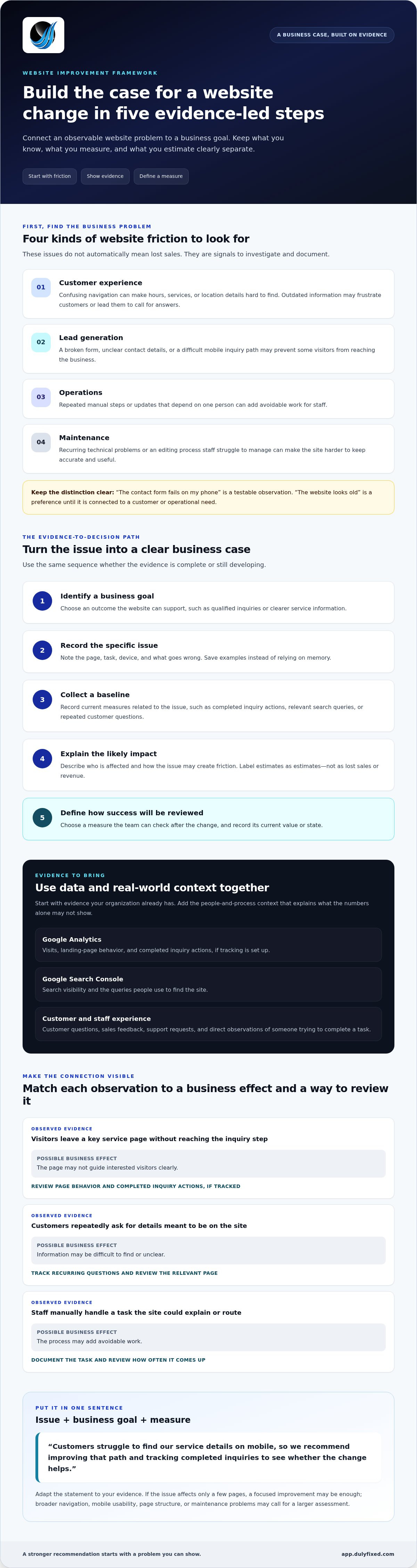
Look for recurring problems across four areas. They donât automatically mean lost sales, but they can create obstacles worth investigating:
- Customer experience: Confusing navigation can make it harder to find hours, services, or location details. Outdated information may frustrate customers or prompt them to call for answers.
- Lead generation: A broken form, unclear contact details, or a difficult mobile inquiry path may prevent some visitors from reaching the business.
- Operations: If routine updates require repeated manual steps or depend on one person, the site may be adding avoidable work.
- Maintenance: Recurring technical problems or an editing process staff struggle to manage can make the site harder to keep accurate and useful.
Separate what you can verify from what you suspect. Record customer complaints, missed or incomplete inquiries, repeated support questions, and tasks staff handle manually. Then check the page or process involved. âThe contact form fails on my phoneâ is a testable observation. âThe website looks oldâ is a preference until you connect it to a customer or operational need.
When is a refresh enough, and when is a new website worth exploring?
If a few pages contain outdated details or one layout makes important information hard to find, a focused content or design refresh may address the problem with less disruption. If navigation, mobile usability, page structure, and maintenance issues affect the site broadly, assess whether a larger project makes sense. The website development process can involve both visible page design and behind-the-scenes functionality, so the scope should reflect what needs to change.
Define the problem before recommending a solution. List the affected pages, who encounters the issue, how often it appears, and what task becomes harder. That evidence may point to a targeted improvement rather than a full rebuild. Either way, focus your case on what the business needs the site to do, not which design trend it should follow.
How to build a business case for a new website with evidence
A persuasive proposal connects a website problem to a business goal, then explains how the team can tell whether a change helped. Keep observations, measured data, and estimates separate. That makes your recommendation more credible, even if the available evidence is incomplete.
What website data should you bring to your boss?
Start with evidence your organization already has. If tracking is set up, Google Analytics can show visits, landing-page behavior, and completed inquiry actions. Google Search Console can help you review search visibility and the queries people use to find the site. Add context from customer questions, sales feedback, support requests, and direct observations of someone trying to complete a task. As Website Development: A Beginner's Guide explains, a website project can involve more than its visible design, so identify which parts of the site need attention.
How do you connect website issues to business goals?
Build the case in five steps:
- Identify a goal. Choose a business outcome the site can support, such as qualified inquiries or clearer service information.
- Record the issue. Note the page, task, device, and what goes wrong. Save examples rather than relying on memory.
- Collect a baseline. Record current measures related to the issue, such as completed inquiry actions, relevant search queries, or repeated customer questions.
- Estimate the impact. Explain who is affected and how the issue may create friction. Label estimates as estimates. Donât present them as lost sales or revenue.
- Define success. Pick a measure the team can review after changes, and record its current value or state.
| Evidence | Likely business effect | Measurement method |
|---|---|---|
| Visitors leave a key service page without reaching the inquiry step | The page may not guide interested visitors clearly | Review page behavior and completed inquiry actions, if tracked |
| Customers repeatedly ask for details already meant to be on the site | Information may be difficult to find or unclear | Track recurring questions and review the relevant page |
| Staff manually handle a task the site could explain or route | The process may add avoidable work | Document the task and review how often it comes up |
A concise proposal sentence could read: âCustomers struggle to find our service details on mobile, so we recommend improving that path and tracking completed inquiries to see whether the change helps.â Adapt it to your evidence. Present the issue, its business objective, and the measure together. If your evidence points to a focused improvement, discuss a website scope tied to the documented problem with Dulyfixed Small Business Solutions. For businesses in Soap Lake, Ephrata, Moses Lake, Wenatchee, and Seattle, the same principle applies: ground the recommendation in the tasks customers need to complete on your site.
Website refresh, landing page, or full redesign: which option fits?
The right scope is the smallest one that addresses the documented problem without leaving important issues in place. A full redesign isnât automatically better. If youâre weighing how to convince my boss we need a new website, show why the proposed option fits the issue, what it will affect, and how youâll measure progress.
- Content or design refresh: Best when the site structure works but a few pages need clearer copy, updated details, or a more usable layout. It affects less of the site, but wonât resolve problems caused by broader navigation or technical constraints.
- Focused landing page: Useful when one audience, service, or campaign needs a direct path to a specific action. It keeps the message focused and gives the team a clear place to measure activity, but wonât fix unrelated problems elsewhere on the site.
- Broader redesign: Worth assessing when several pages, navigation, mobile usability, or maintenance processes need coordinated attention. It can address connected problems, but requires more planning for content, site structure, review, and ongoing maintenance.
When can a focused landing page solve the problem?
Choose a landing page when the audience and goal are specific, such as explaining one service and guiding visitors toward an inquiry. Focused messaging reduces competing paths, while a mobile-first layout makes the next step clear on smaller screens. Dulyfixed develops landing pages for businesses whose evidence points to a campaign or service page rather than a site-wide issue.
A landing page can also provide a contained way to evaluate a defined message and action. Donât use it to mask deeper problems, such as confusing navigation across the main site or outdated information on multiple pages.
When does a broader website redesign make more sense?
Consider a broader project when the issues are connected: visitors struggle to move between key pages, content is hard to organize, mobile usability needs attention across the site, or staff find routine updates difficult. Include ongoing care in the scope. Dulyfixed provides managed hosting and technical support for website maintenance needs. A redesign alone wonât define who updates content or how the site will be maintained, so assign those responsibilities as part of the plan.
Before recommending a scope, map each issue to the pages, tasks, and staff affected. Then compare the disruption, content work, maintenance needs, and success measures for each option. This keeps the decision anchored to the business problem instead of a preference for a particular look.
How to present your website proposal and handle your bossâs objections
A strong proposal makes the decision clear. It doesnât ask your boss to approve a vague ânew website.â It explains whatâs getting in the way, why it matters, and what decision you need. Keep the focus on business purpose, not design preference, when making the case for a new website.
Organize your proposal around six points:
- Problem: Describe the specific website issue and who it affects.
- Evidence: Share the data, customer feedback, or direct observations behind your concern.
- Recommended scope: Explain the smallest project that addresses the problem.
- Alternatives: Compare a refresh, a focused landing page, or a broader redesign, including what each would and wouldnât resolve.
- Success measures: Name the existing baseline and the measures the team could review after the work.
- Requested decision: Ask for a defined next step, such as approval to assess a focused project or prepare a detailed scope.
Address the central objection directly: a visual refresh alone may not justify the investment. Connect the proposed work to an objective, such as making service information easier to find or simplifying the inquiry path. A sample presentation line might be: âOur current service pages are difficult to navigate on mobile, so I recommend improving those pages and reviewing inquiry activity afterward to assess whether the change helps.â It states the evidence and intended measure without promising a result.
âWhy canât we just update the current site?â
That may be the right choice. If the issue is limited to outdated copy or one confusing page, updating the existing site could be enough. If the problem comes from navigation, site structure, or functionality that affects several areas, a patch may leave the main friction in place. Explain what can be changed in place, what depends on broader work, and the trade-offs in disruption and ongoing maintenance.
How should you answer concerns about cost, risk, and timing?
Donât speculate about return or promise a particular outcome. Show how the project can be scoped around the priority problem, with requirements and responsibilities made clear before work begins. If a full redesign is hard to approve, propose a focused first step and agree on how it will be evaluated. A clear scope helps your boss understand what the decision covers and what remains outside it.
Discuss your website goalsWhat to do after your boss approves a new website
Approval is the start of the project, not the finish line. Turn the decision into a written brief before design or development begins. The evidence that helped you make the case should now guide what gets built, what stays out of scope, and how the team will assess the result.
What belongs in a practical website project brief?
Keep the brief focused on the business case. Document who the site needs to serve, the actions visitors should be able to take, the problems identified, and the pages or functions needed to address them. Include practical constraints, such as existing systems or content that must remain. Avoid adding unrelated features simply because theyâre possible.
Clarify responsibilities early. Name who will provide and approve copy, images, website access, and current analytics or search data. This prevents avoidable delays and makes it clear who owns each decision. Before launch, record baseline measures tied to the project goal, such as inquiry actions or repeated questions. Agree on who will review them and when, so the team can compare the same measures after launch.
How can Dulyfixed support a website project?
Dulyfixed develops mobile-first websites and landing pages, with scope shaped around the approved needs. For a focused campaign, a landing page may be the right fit. For broader issues, a coordinated site project can address several pages and their structure. Dulyfixed also provides SEO-ready site structures, managed hosting, and technical support to support the projectâs requirements. These services help businesses in Soap Lake, Ephrata, Moses Lake, Wenatchee, and Seattle plan a site around customer needs and day-to-day operations.
Keep the handoff practical: share the brief, evidence, priorities, content responsibilities, and measures for review. That gives the project a clear starting point and keeps decisions tied to the problem your boss approved.
Start a website conversationTurn your website case into a clear next step
A strong website proposal connects a documented problem to a business goal. Use evidence from customer behavior, staff feedback, and available data, then recommend the scope that fits. A refresh, a focused landing page, or a broader redesign may each be the right choice. The best answer to how to convince my boss we need a new website is a practical case, not a promise of guaranteed results.
Once you have approval, put the audience, goals, responsibilities, and success measures in writing. That gives the project a clear direction and a way to review its impact after launch. Dulyfixed develops mobile-first websites and landing pages with SEO-ready site structures, and provides managed web hosting and dedicated technical support for relevant project needs.
Discuss your website goals with DulyfixedBring your evidence and priorities to the conversation. Talk with Dulyfixed about a website project and identify a focused next step for your business.
Frequently Asked Questions
How do I convince my boss to approve a new website?
Show a documented website problem, connect it to a business goal, and recommend a scope that fits. For example, explain how visitors struggle to find a key service page and propose improving the relevant pages, then tracking inquiry activity. Bring evidence and ask for a specific next step, such as approval to define the project scope, rather than asking for an open-ended redesign.
What evidence should I show my boss to justify a website redesign?
Bring evidence that connects site issues to customer or staff needs. Depending on whatâs available, review Google Analytics for page behavior and completed inquiry actions, and Google Search Console for search visibility and relevant queries. Add customer questions, sales feedback, support requests, and direct observations of people using the site. Separate measured facts from estimates, and avoid claiming that a site issue caused lost revenue unless you can support that conclusion.
Can we improve our current website instead of building a new one?
Yes. If the problem is limited to outdated information, unclear copy, or a layout on a few pages, a targeted update may be enough. A larger project may be worth assessing if navigation, mobile usability, or site structure creates problems across multiple pages. Identify which issues can be fixed in place and which require broader changes before deciding. The goal is to solve the documented problem, not default to rebuilding everything.
How much does a new business website cost?
The cost depends on the projectâs scope, content needs, functionality, and ongoing requirements, so a useful estimate starts with a clear brief. Define the pages, audience, goals, and technical needs before comparing options. A focused landing page and a broader website project involve different work. Dulyfixed develops mobile-first websites and landing pages. A project conversation can help define the scope and what the work needs to cover.
What if my boss thinks a new website is just about appearance?
Keep the discussion on what the site needs to help customers or staff do. A visual update may matter, but it isnât the business case by itself. Show how a specific issue affects finding information, making an inquiry, or completing a routine task. Then propose a suitable improvement and a measure to review afterward. This keeps the recommendation practical without promising that a new design will automatically increase sales.
Should a small business choose a landing page or a full website redesign?
Choose a landing page when one audience, service, or campaign needs a clear path to a specific action. Consider a broader redesign when problems affect several pages, navigation, content structure, or mobile usability. For businesses in Soap Lake, Ephrata, Moses Lake, Wenatchee, or Seattle, the right scope depends on how people find information and contact the business. Dulyfixed develops both mobile-first websites and landing pages.
How can we measure whether a new website is working?
Set a baseline before launch, then review measures tied to the projectâs goal. These might include completed inquiry actions, behavior on priority pages, relevant search queries, or recurring customer questions. Choose measures the team can access and assign someone to review them at an agreed time. Compare the results with the baseline, while accounting for other factors that may affect activity. This shows what changed without treating every change as proof of cause.
Talk With Dulyfixed
If this article connects with something you are trying to improve, send a note about your website, marketing, search visibility, or AI discovery goals.