
Published October 5, 2026
The price of a small-business website isnât determined by page count alone. A simple site can take more time and support to build than a larger one if it needs original content, booking tools, or custom features. So, how much to build a website for a small business? The answer depends on what the site needs to do, who builds it, and who will manage it after launch.
If youâre weighing a DIY builder against a template-based setup or a custom build, itâs easy to focus on the upfront cost and miss the ongoing work. Hosting, updates, security, and content all affect the budget. So does deciding which features your business needs at launch and which can wait.
This guide breaks down the main cost drivers without relying on a one-size-fits-all average. Youâll compare build approaches, identify expenses that continue after launch, and learn how to scope a practical site around your goals and available time. The aim is a budget that covers both getting online and keeping your website useful over time.
Key Takeaways
- To estimate how much to build a website for a small business, define its goals, features, and support needs before comparing costs.
- Separate one-time build work from recurring responsibilities such as hosting, maintenance, content updates, and domain renewals.
- Compare DIY, freelancer, and agency approaches by the time, technical work, customization, and ongoing updates each requires.
- Prioritize the pages and features your business needs at launch, then plan later improvements as your needs become clearer.
- Mobile-first design, clear messaging, and an SEO-ready structure help connect your websiteâs scope to the outcomes you want.
Table of Contents
- How much does a small-business website cost, and what does the budget cover?
- DIY, freelancer, or agency: which website-building approach fits your business?
- What drives the cost of building a small-business website?
- How to define a website budget before requesting a project proposal
- A practical small-business website plan with Dulyfixed
How much does a small-business website cost, and what does the budget cover?
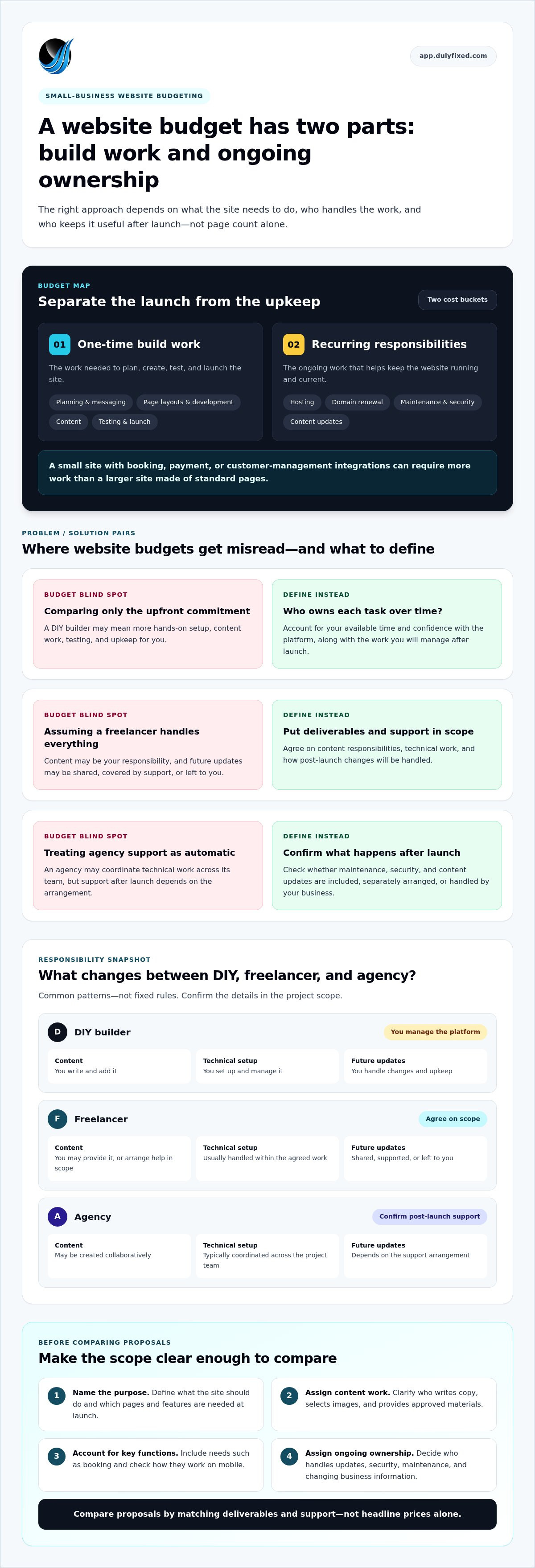
Thereâs no single reliable total for a small-business website without defining its scope, functionality, and support needs. The budget may cover one-time work to plan, design, build, and launch the site, plus recurring expenses such as hosting, domain renewal, maintenance, and content updates.
A useful website budget reflects what the site needs to do and who will keep it working, not just how many pages it has. A small site with custom booking, payment, or customer-management integrations can require more work than a larger site built from standard pages. Technical development includes more than what visitors see. Web development also involves building and maintaining a siteâs technical foundation.
What is included in a small-business website build?
A build may include planning the siteâs purpose, shaping its messaging, designing page layouts, developing the site, adding content, testing key functions, and preparing for launch. The exact scope depends on the business and the features it needs.
For example, a local service business might need pages that explain its services, introduce the team, and make it easy to request an appointment. If customers also need to book online, the project must account for that functionality, including how it works on mobile devices and what happens after a booking is submitted. Having approved text and photos ready can reduce content work during the build.
Which website expenses continue after launch?
Plan separately for hosting, domain renewal, maintenance, security, and content updates. These needs vary by platform, site complexity, and support arrangement. A simple site that rarely changes may need a different update routine from one with frequent promotions, new services, or interactive features.
Before launch, decide who will handle software updates, monitor security, and make changes when business information shifts. Reviewing a website maintenance checklist can help you identify recurring tasks and assign responsibility. Treat ongoing support as part of the siteâs operating plan, not an afterthought.
DIY, freelancer, or agency: which website-building approach fits your business?
The right approach depends on more than the initial commitment. Consider how much time you can contribute, how customized the site needs to be, and who will handle technical work and updates. A DIY platform gives you direct control, while professional development can shift parts of the process to a specialist. Neither option is automatically best for every business.
| Approach | Content | Technical setup | Future updates |
|---|---|---|---|
| DIY builder | You write and add it | You set up and manage the platform | You handle changes and upkeep |
| Freelancer | You may provide content, or arrange help as part of the scope | Usually handled by the freelancer within the agreed work | May be shared, handled through ongoing support, or left to you |
| Agency | May be created collaboratively, depending on the project | Typically coordinated across the agencyâs project team | Depends on the support arrangement after launch |
These are common patterns, not fixed rules. Define responsibilities before work begins, especially for writing, image selection, platform access, and post-launch changes. When comparing proposals, check whether each includes the same deliverables and support rather than comparing headline prices alone.
When can a DIY website builder be a practical choice?
DIY can suit a business with straightforward needs, available time, and confidence working inside a website platform. Templates give you a prepared layout, but may limit how far you can tailor the design or structure. You remain responsible for the content, setup, testing, and upkeep. The lower upfront commitment may therefore require more hands-on effort over time.
Before choosing a builder, list the tasks youâll need to manage: writing page copy, selecting images, setting up navigation, checking forms, and making updates. If those tasks compete with core business work, include the value of your time when comparing options.
When does professional website development make sense?
Professional help can be useful when you need sharper messaging, conversion-focused pages, mobile-first design, or technical support. A clearly scoped project makes collaboration more manageable. Agree on the siteâs purpose, required pages, features, content responsibilities, and launch needs before development begins. If one focused page is meant to generate leads, explore the principles behind professional landing page design as part of shaping the scope.
To work out how much to build a website for a small business, weigh the investment alongside the time and responsibility each approach leaves with you. The U.S. Small Business Administration includes making a website among startup expenses in its guide to calculating startup costs. If professional development fits your goals, you can discuss your website project with Dulyfixed.
What drives the cost of building a small-business website?
Website project scope is shaped by the work required, not simply by the number of pages. A concise site with original messaging, appointment booking, and connections to other business tools may take more planning and development than a larger set of straightforward information pages. Guides such as Forbesâ overview of how much a website costs also distinguish between build approaches and ongoing expenses. Your requirements determine the work your project needs.
Functionality and content can shape a website project more than page count because they determine what the site must communicate and how it must work.
How do content, design, and functionality change project scope?
A basic informational site may present services, business details, and a way to get in touch. Add booking, payment processing, or an integration with a customer-management system, and the project must account for those features and how they work together. Each function needs clear requirements and testing, not just space on a page.
Content readiness matters, too. Approved copy, photos, and service details give the build team material to organize and place. If the message is still unclear or content needs to be developed, the project also needs time for planning and revisions. A standard template can make setup more direct, while a tailored experience allows more control over layouts and how visitors move toward an action. That flexibility requires additional design and development work.
Which technical and support requirements belong in the plan?
Set practical requirements for how the site should work on phones, how pages should be organized for search engines, and how reliably the site should perform. Mobile-first design means planning for small screens from the start, not just shrinking a desktop layout. Before launch, test key pages, forms, links, and other essential functions on the devices visitors are likely to use.
Hosting and technical support also belong in the plan, but theyâre distinct from initial design and development. A site needs a hosting arrangement, while ongoing support can cover technical care after launch. Clarify who handles updates and what support includes so these responsibilities donât get overlooked. Dulyfixed provides managed web hosting and technical support to address ongoing site needs.
To estimate how much to build a website for a small business, write down the content, features, integrations, mobile requirements, and support responsibilities the site needs. That scope gives you a more useful basis for comparing proposals than page count alone.
How to define a website budget before requesting a project proposal
A useful budget starts with a clear brief, not a guess based on page count. Define what the site must accomplish, what needs to be ready at launch, and who will handle the work afterward. This gives you a shared basis for discussing scope and comparing proposals.
- Set the business goal. Decide what the website should help your business do, such as explain a service, generate inquiries, or let customers book.
- Name the audience and action. Describe who the site is for and what you want visitors to do next.
- List essential pages and content. Note which pages are needed and who will supply or approve the text, photos, and business details.
- Identify required functions. Include forms, booking, payment, or integrations only if they support the launch goal.
- Set technical and support expectations. State mobile needs, SEO-ready structure, hosting, testing, launch support, and who will manage future updates.
- Prioritize the features. Separate must-haves for launch from enhancements that can wait, then use that list to guide the proposal.
What should a small-business website brief include?
Keep the brief specific enough to guide decisions: primary audience, business goal, core message, and desired visitor action. Add essential pages, content owners, forms, and necessary integrations. Record mobile, site structure, hosting, and post-launch support expectations as well. A clear brief helps prevent assumptions, such as expecting a booking feature or ongoing updates when they werenât included in the agreed scope.
How can you compare proposals fairly?
Compare what each proposal includes, not just its total. Check that they address the same pages, content responsibilities, functions, testing, launch support, ownership, hosting, and ongoing care. Also compare deliverables and how project communication is handled. Dulyfixedâs website development combines mobile-first design, clear messaging, and SEO-ready structure with performance in mind. Managed hosting and technical support can address ongoing site needs.
Once your priorities are clear, it becomes easier to discuss how much to build a website for a small business without confusing launch work with future improvements. Put the agreed scope, responsibilities, deliverables, and ongoing needs in writing before work begins.
Discuss your website projectA practical small-business website plan with Dulyfixed
A useful website starts with a clear business goal. Dulyfixed develops mobile-first websites and landing pages around what your business needs the site to do, whether that means explaining services, helping visitors find key information, or encouraging people to get in touch. A focused scope keeps the work centered on the visitorâs needs instead of adding features without a clear purpose.
What does a focused website project need to accomplish?
Start with the visitorâs question: What do they need to understand before taking the next step? The siteâs message should answer that clearly, then make the next action easy to find. For a service business, that might mean concise service details and a straightforward path to contact.
Prioritize mobile usability and essential content. Visitors should be able to read, navigate, and use important features on a phone without unnecessary friction. A lead-generation goal may call for a focused landing page rather than a large collection of pages. Explore professional landing page design as an approach when a single offer or service needs a clear path to inquiry.
Dulyfixed brings together clear messaging, SEO-ready site structure, and performance-conscious design. These choices help organize useful information and support a smoother visitor experience. They can give search engines a clearer structure to interpret, but they donât guarantee rankings. The right scope depends on your audience, your offer, and the action you want visitors to take.
What happens after the website launches?
Launch is the start of the siteâs ongoing responsibilities. Hosting keeps the website available online, while technical support helps address site-related needs after launch. Content also needs an owner. Service details, contact information, and other business updates can become outdated if no one is responsible for keeping them current.
Dulyfixed provides managed web hosting and technical support alongside website development. Including those needs in your plan helps you account for who supports the site once the initial design and build work are complete. Based in Soap Lake, Dulyfixed serves nearby communities, including Ephrata, Moses Lake, and Wenatchee, as well as Seattle.
As you weigh how much to build a website for a small business, connect the project scope to the outcome you want and the support youâll need afterward. Dulyfixed can tailor website and landing page development to your business goals.
Talk through your website goalsBuild a Website Budget Around Your Business Goals
Thereâs no reliable one-size-fits-all answer to how much to build a website for a small business. The cost depends on the siteâs purpose, features, content needs, and who will handle the work. Choose a DIY, freelance, or agency approach based on your goals and the time and technical capacity you can contribute.
Before requesting a proposal, define what the site must accomplish, separate launch essentials from later improvements, and account for hosting, updates, and support after launch. A clear scope makes it easier to compare proposals and plan for the siteâs full life, not just its initial build.
Dulyfixed develops mobile-first websites and landing pages with SEO-ready structures and performance-conscious design. Managed hosting and technical support can also address what the site needs after launch. Start with a focused conversation about your goals and the right scope for your business.
Discuss your small-business website projectA practical plan gives your website a clear purpose and a stronger foundation for serving your business as it grows.
Frequently Asked Questions
How much does it cost to build a website for a small business?
Thereâs no reliable single cost without knowing what the site needs to do. To estimate how much to build a website for a small business, define its purpose, content, required features, and who will handle the technical work. A straightforward informational site has different needs from one with booking, payments, or integrations. Include ongoing hosting, domain renewal, maintenance, and content updates in your budget, not just the initial build.
What is the cheapest way to build a small-business website?
A DIY website builder can be the lowest-commitment starting point for a business with simple needs and time to manage the work. Youâll handle writing and adding content, setting up the site, testing it, and making updates. Templates can speed up setup but may limit customization. Account for platform and domain expenses, as well as the value of your time and any help needed to fill gaps.
Can I build a small-business website myself?
Yes, you can build a small-business website yourself if youâre comfortable managing a website platform and the siteâs needs are manageable. Plan to create or gather the content, organize pages, set up the site, check it on mobile devices, and maintain it after launch. If you need custom functionality or technical support, professional help may make more sense. Choose an approach that fits your time and skills.
What should be included in a small-business website quote?
A useful quote should describe the project scope and make responsibilities clear. Look for the planned pages and features, design and development work, content responsibilities, testing, and launch support. It should also state who owns or manages the site, what hosting arrangement applies, and what post-launch updates or technical support cover. Compare proposals against the same requirements so differences in scope donât get mistaken for differences in value.
How much does it cost to maintain a small-business website?
Thereâs no fixed maintenance cost that applies to every small-business site. Ongoing expenses depend on the platform, site complexity, and support arrangement. Plan for hosting and domain renewal, plus the work needed to maintain security, handle technical updates, and keep content current. Assign responsibility for each task and clarify whether itâs part of an ongoing support plan or handled separately. That gives you a clearer view of the siteâs continuing budget.
How long does it take to build a small-business website?
Build time depends on the project scope and how quickly decisions and materials are ready. A site with approved copy, images, and a clear page plan has fewer open questions than one that needs content planning or custom features. Integrations, revisions, testing, and feedback also affect the schedule. Before work begins, agree on the required deliverables, who supplies content, and how review and approval will happen.
Is a professional website worth it for a small business?
A professional website can be worthwhile if it helps customers understand your offer and take a clear next step. Mobile usability, strong messaging, a search-friendly structure, and reliable performance all contribute to a useful experience, though no site can guarantee rankings or sales. Dulyfixed Small Business Solutions serves businesses in Soap Lake, Ephrata, Moses Lake, Wenatchee, and Seattle with mobile-first website and landing page development, managed hosting, and technical support.
Talk With Dulyfixed
If this article connects with something you are trying to improve, send a note about your website, marketing, search visibility, or AI discovery goals.