
Published September 7, 2026
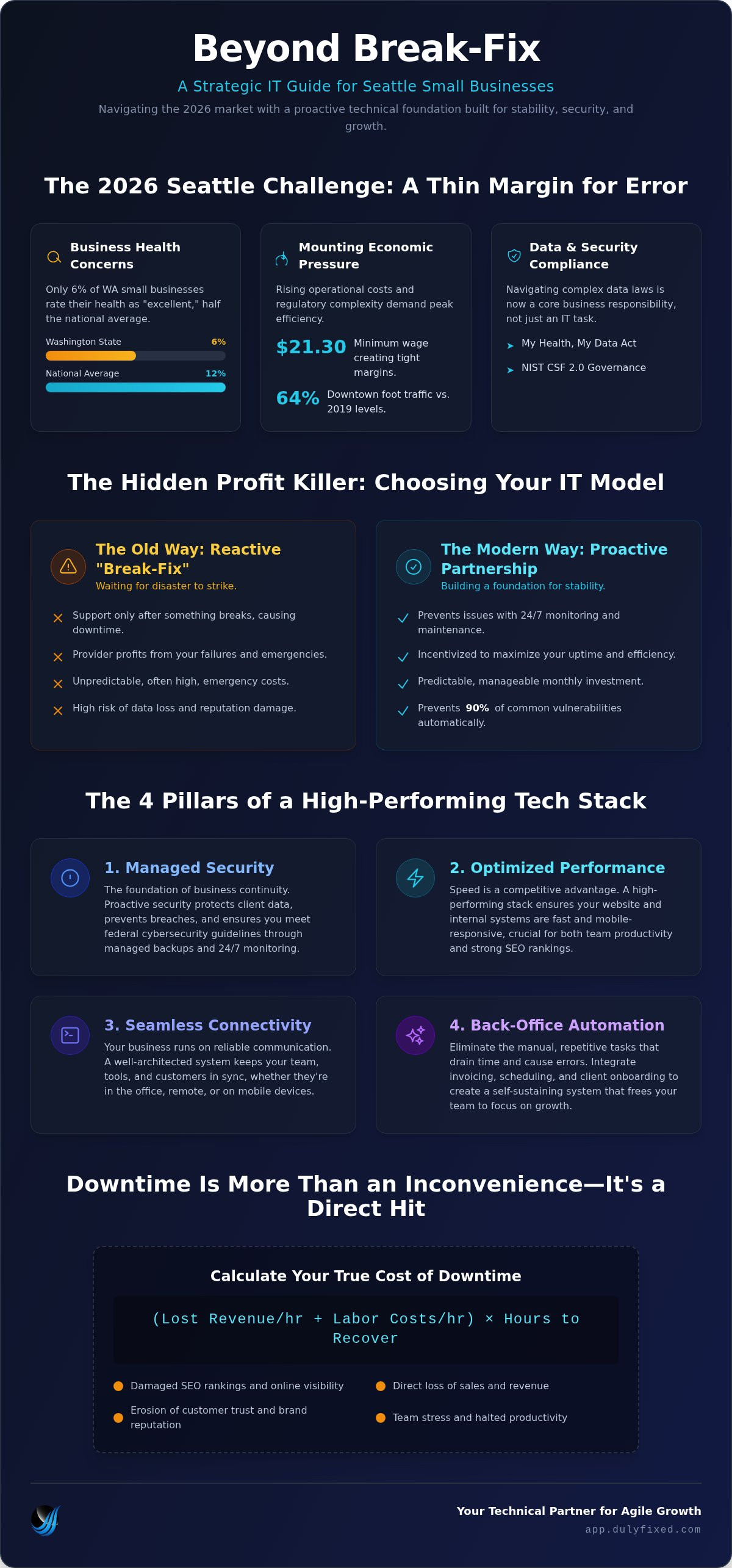
Only 6% of Washington small business owners rate their companyâs health as "excellent," a figure that is half the national average in 2026. If youâre managing a team in King County, you already know why. Between the $21.30 minimum wage and the complexity of the My Health, My Data Act, the margin for error has never been thinner. You don't have time to waste on reactive small business IT support Seattle that only shows up when something breaks. You need a technical environment that stays stable so you can focus on your actual work.
We agree that technology should be a tool for momentum, not a source of constant frustration or fear regarding data loss. This strategic guide promises to move you beyond basic troubleshooting. Youâll discover how to build a secure foundation that meets NIST CSF 2.0 standards while automating the manual back-office tasks that eat your afternoon. We will preview the shift from traditional "break-fix" models to a proactive partnership. This approach ensures your systems are secure, your workflows are efficient, and your technical partner explains everything in plain English.
Key Takeaways
- Learn why the traditional "break-fix" model is a hidden profit killer and how proactive maintenance prevents costly downtime.
- Discover the four essential pillars of a high-performing tech stack, focusing on managed backups and mobile-first system speeds.
- Compare rigid service contracts against flexible technical partners to find the right small business IT support Seattle requires for agile growth.
- Follow a streamlined 5-step audit to inventory your hardware and software while identifying performance bottlenecks.
- Understand the critical connection between server security and SEO rankings to ensure your marketing efforts drive real results.
Table of Contents
- Why Seattle Small Businesses Need Strategic IT Support in 2026
- The 4 Pillars of a High-Performing Small Business Tech Stack
- Evaluating IT Support Models: Managed Services vs. Technical Partners
- How to Conduct a 5-Step Technical Audit of Your Business
- Integrating IT Support with Digital Growth and SEO
Why Seattle Small Businesses Need Strategic IT Support in 2026
Small business IT support Seattle is no longer just a "help desk" you call when a laptop won't boot. In 2026, IT support has evolved into a holistic service that bridges the gap between security, system performance, and back-office automation. For local owners managing a $21.30 minimum wage and tight margins, technology must do more than just work; it must generate efficiency. Relying on the old "break-fix" model is a hidden profit killer. When you only pay for support after something breaks, your provider essentially profits from your downtime. A strategic partner flips this incentive, focusing on uptime and stability to keep your operations lean.
The Seattle market is uniquely competitive. With downtown worker foot traffic still recovering at 64% of 2019 levels, your digital presence and internal speed are non-negotiable. Large Managed Service Providers (MSPs) often treat small firms like a ticket number, offering rigid contracts that lack agility. A dedicated technical support partner acts as a "fixer," providing the high-level expertise of a CTO without the executive salary. This model prioritizes local expertise and quick pivots, which are essential for navigating Washingtonâs complex regulatory environment.
The Real Cost of Technical Downtime
Downtime is more than an inconvenience; it's a direct hit to your reputation. If your website or client portal goes dark for even five minutes, your local SEO rankings can slip as Google detects a "bad" user experience. Beyond the data, the psychological stress on a small team is immense. When systems fail during peak hours, productivity halts while wages continue to accrue. You can calculate your actual risk using a simple framework: add your lost revenue per hour to your total hourly labor costs, then multiply by the hours it takes to recover. Most Seattle owners find this number is significantly higher than the cost of a monthly support plan.
Moving from Reactive to Proactive Tech Management
Modern stability requires moving away from reactive patches. Different Technical Support Models offer various tiers of response, but for a local firm, the speed of resolution is what keeps the lights on. Proactive management involves 24/7 monitoring and technical support that identifies a failing drive or a security breach before you even notice a glitch. This approach aligns with the NIST Cybersecurity Framework 2.0, which now emphasizes "Governance" as a core business responsibility. By automating updates and hosting, you prevent 90% of common vulnerabilities, ensuring your business remains compliant with the My Health, My Data Act without manual oversight.
The 4 Pillars of a High-Performing Small Business Tech Stack
A high-performing tech stack is the engine room of your company. It transforms your operations from a series of manual struggles into a streamlined system that scales. Effective small business IT support Seattle focuses on four specific pillars: security, performance, connectivity, and automation. Security ensures business continuity through managed backups. Performance keeps your systems fast and mobile-responsive. Connectivity keeps your team and customers in sync. Finally, automation removes the friction from back-office tasks, allowing you to focus on growth rather than paperwork.
Managed Web Hosting and Security
Relying on generic, $5 monthly hosting is a liability for any professional organization. These shared environments often lack the resources to handle traffic spikes and offer minimal protection against breaches. A strategic approach requires Dulyfixed Services like managed hosting, which provides an SEO-ready site structure and isolated server resources. This setup is critical for following federal cybersecurity guidance regarding data protection. When your hosting environment is secure and optimized, you protect your client data and your search engine rankings simultaneously.
Back-Office Automation for Daily Efficiency
Automation is the silent partner that works while you sleep. By integrating your invoicing, client onboarding, and scheduling tools, you eliminate the repetitive data entry that leads to human error. For example, a new client signing a contract can automatically trigger an invoice and a welcome sequence without a single manual click. This synchronization frees up creative energy and ensures no leads fall through the cracks. It turns a chaotic back office into a predictable, efficient system that supports a larger volume of business without increasing your headcount.
Mobile-First Infrastructure
In 2026, the mobile experience is the only experience that matters for local search visibility. If your internal systems or customer-facing sites aren't optimized for smartphones, you're losing customers before they even see your offer. Site speed correlates directly with how high you appear in local results. This is why we treat Professional Landing Page Design as a core IT pillar rather than just a marketing task. Design and IT must work together to ensure your digital presence is lightweight, fast, and accessible on any device. If you aren't sure where your current stack stands, it might be time to reach out for a technical review of your environment.
Evaluating IT Support Models: Managed Services vs. Technical Partners
Deciding how to manage your technology often comes down to a choice between a vendor and a teammate. Traditional Managed Service Providers (MSPs) rely on a standardized, fixed-fee model that prioritizes volume. While this provides budget consistency, it can feel impersonal for agile firms. An agile technical partner, however, functions as an extension of your own team. They adapt to your specific projects and marketing goals rather than forcing you into a rigid service bucket. Understanding the nuances of different Technical Support Models is the first step in finding the right small business IT support Seattle needs to scale.
| Feature | Fixed-Fee MSP | Agile Technical Partner |
|---|---|---|
| Contract Length | Typically 12 to 36 months | Flexible or month-to-month |
| Support Style | Tiered ticket system | Direct access to senior experts |
| Business Goal | Standardized stability | Growth and digital performance |
| Incentive | Minimize time per ticket | Maximize client efficiency |
Watch out for proprietary lock-ins when reviewing contracts. Some providers use custom software tools that make it difficult to migrate your data if you decide to leave. Another common red flag is hidden hardware markups. A transparent partner will let you own your assets directly, from domain names to server licenses. "Human-first" support isn't just a catchphrase; it's the difference between waiting for a Tier-1 script reader and talking to a "fixer" who knows your business by name.
What Small Businesses Should Look for in a Seattle IT Provider
Choosing the right small business IT support Seattle offers means finding a team that bridges the gap between hardware and high-speed web performance. In a market where remote-first workflows are the standard, you need a partner who understands cloud connectivity as well as they understand SEO. Look for a team that communicates in plain English. If they hide behind exclusionary jargon, they likely don't have a deep enough understanding to explain how technology drives your bottom line. A local expert understands the unique pressures of the Pacific Northwest, including high labor costs and complex data privacy regulations.
Transparency and Predictable Budgeting
Surprise costs can wreck a small business budget. Common "gotchas" include onboarding fees or emergency rates that kick in far too early in the day. While the lowest monthly price might seem like a bargain, it often results in the highest long-term costs due to reactive repairs. Investing in proactive technical support creates a predictable spending path. Transparency means you always know what you're paying for and why it matters. If you're tired of confusing invoices and robotic support, itâs time to start a conversation about a more agile, transparent partnership.
How to Conduct a 5-Step Technical Audit of Your Business
A technical audit isn't just about counting laptops. It's a pragmatic way to ensure your small business IT support Seattle is actually delivering value rather than just collecting a fee. By identifying gaps in your stack, you can stop "bleeding" productivity and budget. Follow this checklist to get a clear picture of where you stand in 2026.
The 2026 Technical Audit Checklist
- Inventory Your Stack: List every piece of hardware, software license, and monthly subscription. You'll likely find "zombie" subscriptions for tools your team no longer uses.
- Test Mobile-First Performance: Check your website and internal tools for smartphone speed. In a market where digital presence is non-negotiable, a three-second delay is a dealbreaker.
- Verify Backup Integrity: Confirm that your data is backing up daily. More importantly, attempt a test restore. A backup you can't open is useless.
- Spot Automation Gaps: Look for tasks your team does manually every week, like data entry or invoice reminders. These are prime candidates for back-office automation.
- Review Security Protocols: Check password hygiene and ensure Multi-Factor Authentication (MFA) is active across all platforms.
Callout Tip: When auditing software, look for "shadow IT." These are apps employees use without official approval. They often create security holes and redundant costs that a strategic partner can help you consolidate.
Testing Your Digital Foundation
Your website is often the first point of contact for local customers. Use free tools like Google PageSpeed Insights to check your mobile performance and SEO-ready site structure. If your scores are in the red, your technical foundation is crumbling. Consistent site maintenance is a non-negotiable part of this audit because it prevents small glitches from becoming site-wide crashes. For a detailed framework on what to check monthly, review our Website Maintenance Wenatchee Checklist.
Reviewing Security and Continuity
Security isn't a one-time setup; it's a constant perimeter. Managed hosting plays a vital role here by providing a secure environment that blocks threats before they reach your data. During your audit, test your "continuity." Continuity is the ability to work from anywhere if your primary office is inaccessible. If a power outage or a network failure happens, your team should be able to pivot to remote work without losing a single hour of productivity. This level of resilience is what separates a stable business from one that is always in crisis mode.
Schedule a professional technical audit for your businessIntegrating IT Support with Digital Growth and SEO
Small business IT support Seattle shouldn't live in a vacuum. Many business owners make the mistake of separating their "tech guy" from their "marketing team," but these two functions are deeply linked. If your technical foundation is shaky, your marketing budget is effectively being wasted. A slow server or a lack of security protocols doesn't just annoy your visitors; it signals to search engines that your business is a risk. When your infrastructure is optimized, it doesn't just stay online; it actively helps you rank higher and convert more leads.
Why Technical Infrastructure is the Backbone of SEO
Google's Core Web Vitals are the modern standard for measuring user experience. If your IT provider doesn't understand metrics like Largest Contentful Paint (LCP), they can't effectively support your SEO goals. High-performance managed hosting ensures your "crawl budget" is used efficiently, allowing search bots to index your pages without hitting server bottlenecks. This technical alignment is why our Seattle Law Firm Landing Pages Guide prioritizes server speed as much as it does legal copywriting. A fast, secure site is the prerequisite for any successful digital campaign.
Choosing a Growth-Oriented Partner
You need a partner who understands "Commercial Creative Services" as well as they understand server maintenance. Stability is the floor, but growth is the ceiling. At Dulyfixed, we act as the bridge between technical stability and commercial success. We integrate digital video production and back-office automation directly into your tech stack. This ensures that when a lead lands on your mobile-first website, the system is fast enough to keep them there and automated enough to capture their information immediately.
Commercial success in the competitive Seattle market requires a "fixer" who looks at the big picture. We don't just patch servers; we build the engine that drives your business forward. By combining technical stability with strategic marketing tools, we turn your IT from a monthly expense into a growth asset. If you're tired of tech support that doesn't understand your business goals, it's time to shift your strategy toward a more integrated approach.
Contact Dulyfixed for a pragmatic tech solutionBuilding a Resilient Technical Future for Your Seattle Business
Modern small business IT support Seattle is no longer a luxury or a reactive expense. It's the technical foundation that allows your marketing to succeed and your team to operate without friction. By auditing your stack and moving toward proactive management, you protect your company from the rising costs of downtime and the stress of data loss. Stability is just the beginning of the journey.
The real competitive advantage in 2026 comes from a partner who understands how managed hosting, SEO-ready structures, and back-office automation work together. Dulyfixed brings decades of real-world experience to bridge the gap between technical reliability and commercial growth. We provide pragmatic, fluff-free guidance that integrates your digital presence with your daily operations, ensuring your tech stack works as hard as you do.
Explore Strategic IT and Web Solutions for Your BusinessYou don't have to navigate these complex digital shifts alone. With a pragmatic strategy and a reliable fixer in your corner, you can focus on building your brand while your technology handles the heavy lifting. Your business deserves a foundation that is stable, secure, and ready for whatever comes next.
Frequently Asked Questions
What is the difference between Managed IT Services and basic tech support?
Basic tech support is reactive, meaning you only call for help after something breaks. This "break-fix" model often leads to unpredictable downtime and high emergency costs. Managed IT services provide proactive maintenance and 24/7 monitoring to prevent issues before they disrupt your business. For small business IT support Seattle, moving to a managed model ensures your technical foundation remains stable and secure, allowing you to focus on growth rather than constant troubleshooting.
How much should a small business in Seattle spend on IT support?
IT spending depends on your team size and the complexity of your security requirements. In the Seattle market, fully managed support typically ranges from $100 to $250 per user each month. While one-off repairs might cost between $100 and $200 per hour, these reactive expenses are unpredictable. Investing in a fixed monthly partnership provides budget transparency and ensures your technology costs align with your long-term business goals rather than emergency fixes.
Does my IT support provider also handle my website and SEO?
Most traditional IT companies ignore marketing, but Dulyfixed bridges the gap between technical stability and commercial growth. We integrate technical support with SEO-ready site structures and managed web hosting. This ensures your server performance directly supports your search rankings. If your IT provider doesn't understand Core Web Vitals or mobile-first design, your marketing efforts will likely struggle against technical bottlenecks that slow down your site and repel local Seattle customers.
What happens if my business data is compromised or lost?
Your recovery time depends entirely on the integrity and frequency of your managed backups. A proactive partner ensures your systems are restorable, not just "backed up." Under Washingtonâs My Health, My Data Act, a breach also carries significant legal risks. We focus on business continuity, which means having a verified plan to get your team back to work within hours rather than days, regardless of the cause of the data loss.
Can IT support help me automate my invoicing and client onboarding?
Modern IT support should include back-office automation to eliminate repetitive manual tasks. We help businesses integrate invoicing and client onboarding tools to create a seamless, hands-off workflow. This reduces human error and frees up your creative energy for higher-value projects. By treating automation as a core part of your tech stack, you turn your back office into a silent partner that drives efficiency without the need to increase your headcount.
Why is mobile-first design important for my IT infrastructure?
Mobile-first design is critical because it dictates how search engines and customers perceive your brand's reliability. In 2026, the majority of local searches in Seattle happen on smartphones. If your technical infrastructure doesn't prioritize mobile speed and responsive layouts, your SEO rankings will suffer. We ensure your managed hosting and site architecture are optimized for the mobile experience, turning your digital presence into a high-speed tool for capturing and converting local leads.
How quickly can a Seattle IT support provider respond to an emergency?
Emergency response times vary, but a reliable partner should provide a clear Service Level Agreement (SLA). While many automated systems leave you in a long ticket queue, we prioritize direct communication to resolve critical failures immediately. For small business IT support Seattle, having a "fixer" who understands your specific environment allows for faster troubleshooting than a distant help desk. Rapid response is about protecting your revenue and maintaining team productivity during a crisis.
Do I need a local Seattle IT company, or is remote support enough?
Remote support handles most daily tasks efficiently, but a local presence is vital for hardware failures and strategic planning. A local provider understands the specific challenges of the Washington business environment, from high labor costs to regional regulations. While we serve clients nationwide from our base in Soap Lake, we maintain a deep focus on the Seattle market. This local expertise ensures your technical solutions are pragmatic, relevant, and physically accessible when it matters most.
Talk With Dulyfixed
If this article connects with something you are trying to improve, send a note about your website, marketing, search visibility, or AI discovery goals.