

Published October 14, 2026
Reliable hosting for small business websites is more than a place to store your site. If it goes offline or loads slowly, customers may have trouble reaching your business, and you may be left figuring out who can fix it. Reliability also depends on how routine upkeep is handled and what support is available when a technical issue comes up.
Look beyond uptime claims. Compare what each hosting arrangement covers, who handles maintenance, and how you can report problems. This guide explains how to assess hosting reliability, distinguish hosting from website maintenance, and decide whether managed support fits your business.
Key Takeaways
- Reliable hosting for small business websites depends on more than server availability. Consider page speed and how technical problems are handled, too.
- Before choosing hosting, clarify performance expectations, security responsibilities, maintenance, and the scope of support.
- Separate hosting from website maintenance so you know which ongoing tasks are handled and which remain your responsibility.
- If you lack time or in-house technical help, managed hosting and troubleshooting support can make website upkeep easier to manage.
What reliable hosting means for a small business website
Web hosting stores a websiteâs files and makes them available online. A web hosting service provides the infrastructure visitors connect to when they open your site. An accessible server alone, however, does not guarantee that every page or feature works as intended.
Reliable hosting for small business websites means visitors can reach the site consistently, routine upkeep is addressed, and help is available when technical issues need troubleshooting. Server availability matters, but reliability also depends on what happens when software needs attention or a site feature stops working.
How hosting reliability affects everyday website use
Hosting supports access to your website, but it does not guarantee fast pages, search rankings, leads, or revenue. Page speed and site function can also depend on the websiteâs code, design, and content.
For example, a customer may visit your site to check your hours. The server could be online, but a slow page or broken contact form may still make it harder to get the information they need. An outage blocks access altogether. If no one is responsible for diagnosing the issue, the disruption may last longer than necessary.
Think of hosting as part of your websiteâs ongoing operation, not just a one-time setup. Dulyfixed Small Business Solutions provides managed web hosting and technical support. Its hosting handles website maintenance and security, and ongoing support is available for troubleshooting. This gives small-business owners a clear place to turn for technical upkeep and site issues.
How to assess hosting reliability and support before choosing
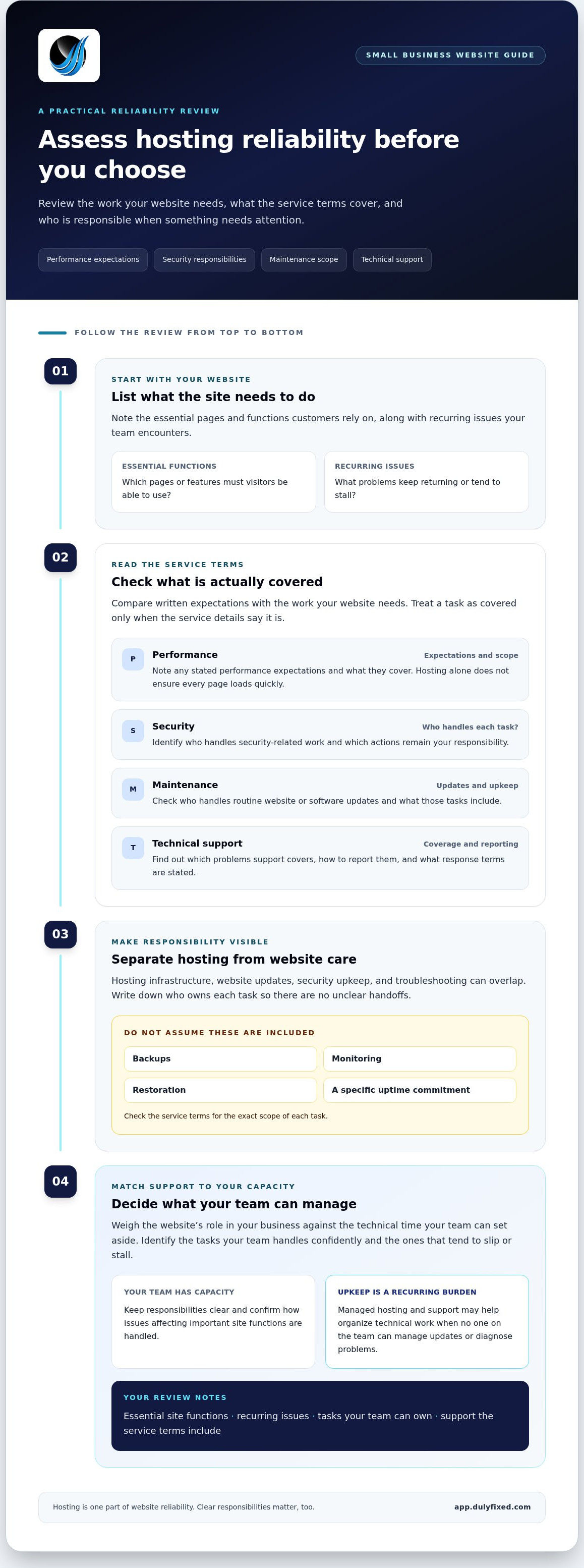
Compare the written service terms with the work your website needs. For reliable hosting for small business websites, look for clear expectations around performance, security, maintenance, and technical support. Treat a task as covered only when the service details say it is.
- Performance: Note any stated performance expectations and what they cover. Hosting alone does not ensure every page will load quickly.
- Security: Identify who handles security-related tasks and which actions remain your responsibility.
- Maintenance: Check who handles routine website or software updates and what those tasks include.
- Support: Find out which problems support covers, how to report them, and what response terms are stated.
Which hosting responsibilities should be clear?
Separate hosting infrastructure from website updates, security upkeep, and troubleshooting. These tasks can overlap, so write down who is responsible for each one. Do not assume backups, monitoring, restoration, or a specific uptime commitment are included. Check the service terms for the exact scope. For a task-by-task review, use this website maintenance checklist.
Next, weigh the websiteâs role in your business against the technical time you can set aside. If customers rely on key site functions, make sure you understand how issues affecting those functions are handled. If no one on your team can manage updates or diagnose problems, consider whether managed support would reduce that workload. Managed hosting and website support is one way to organize these responsibilities.
Make a short list of your siteâs essential functions, recurring issues, and the tasks your team can manage. Use it to identify the support your business needs and explain those needs when reviewing your hosting arrangement.
When managed hosting makes sense for a small business
Managed hosting may suit your business when technical upkeep keeps slipping behind customer work or no one on your team feels equipped to handle website issues. It can also help when you want a clearer division between running the business and managing the technical side of the site.
Handing off technical responsibilities can reduce the work you manage yourself, but you still need to know what remains yours. Keep control of essential business information, know who can access your website accounts, and identify the tasks your team will continue to handle. A clear division of responsibility helps prevent gaps when your site needs attention.
Consider how much time your team spends resolving website problems and whether that time could be better used elsewhere. If technical upkeep is a recurring burden, managed hosting support can help organize that work.
A practical next step for your website
Write down your current hosting arrangement, who handles site changes, and which technical issues keep recurring. Include tasks your team can manage confidently and those that tend to stall. This gives you a concrete starting point for deciding what support would make website operations easier.
Dulyfixed is based in Soap Lake, Washington, and provides managed hosting and technical support for small-business websites.
Make website support part of your plan
Start by defining what your website needs to do for your business, then make responsibility for its technical care clear. This plan reduces guesswork when a problem comes up and helps you judge whether your current setup fits your needs. Reliable hosting for small business websites should match your priorities and the technical capacity you have available.
Before you choose a support arrangement, note your main concern, whether it is routine upkeep or knowing where to turn when a problem appears.
For a practical next step, discuss managed hosting for your small business website with Dulyfixed.
Frequently Asked Questions
Can I change website hosting without rebuilding my website?
Usually, changing hosts does not require rebuilding a website. The siteâs files and any database may be transferred to the new hosting environment, but the steps depend on how the site was built and configured. Before switching, decide who will handle the transfer, test key pages and forms on the new host, and plan the domain change to reduce disruption.
Is free web hosting reliable enough for a small business?
It depends on what the host includes and how customers use your site. Free hosting may be adequate for a temporary or low-stakes project, but review its support, security responsibilities, performance terms, and limits before relying on it for business. If your site brings in inquiries or supports daily operations, choose hosting with support that matches those needs.
What happens if my business website goes down?
Visitors may see an error or be unable to load the site until the cause is fixed. Try the address on another device or network. If the problem persists, note the time and error message, then report them to your hosting support contact. Businesses serving customers in Soap Lake, Ephrata, Moses Lake, Wenatchee, Seattle, Coulee City, Hartline, Wilson Creek, or Marlin can use those details to explain the outage clearly.
Talk With Dulyfixed
If this article connects with something you are trying to improve, send a note about your website, marketing, search visibility, or AI discovery goals.