
Published September 18, 2026
What if your website isn't actually a business asset, but a quiet liability that's leaking local customers to your faster competitors? Most Washington business owners understand the frustration of a site that slows down over time or the constant, nagging fear of a sudden security breach. You want a digital presence that reflects your professional standards, but the reality often involves wading through confusing tech jargon or ignored update notifications. Investing in managed website maintenance isn't just about fixing bugs. It's about ensuring your brand remains visible and trustworthy in an increasingly crowded local market.
You deserve the peace of mind that comes from knowing your technical foundation is rock-solid. This guide explains how proactive management protects your reputation, boosts your local SEO rankings, and turns your site into a high-performance sales engine. We'll explore the essential security protocols for 2026, performance optimization techniques that keep visitors on your page, and the specific ways Dulyfixed helps you reclaim your time. It's time to stop worrying about the "how" of web technology and start focusing on the core operations that actually grow your company.
Key Takeaways
- Shift from "set and forget" to proactive optimization to avoid becoming a digital liability in 2026.
- Discover how managed website maintenance protects your SEO-ready site structure while eliminating the "plugin bloat" that slows down mobile performance.
- Evaluate the true costs of DIY maintenance and recognize the specific risks that can lead to broken pages or lost local customers.
- Use our localized checklist to find a partner who prioritizes transparent health reports and understands the Washington business landscape.
- Learn how consistent technical support serves as the launchpad for back-office automation that streamlines your scheduling and invoicing.
Table of Contents
- What Is Managed Website Maintenance and Why Does It Matter in 2026?
- The Technical Anatomy: Security, Speed, and SEO-Ready Performance
- Managed vs. DIY Maintenance: Finding the Right Balance
- How to Evaluate a Maintenance Partner: A Small Business Checklist
- Scaling Your Operations with Integrated Support and Automation
What Is Managed Website Maintenance and Why Does It Matter in 2026?
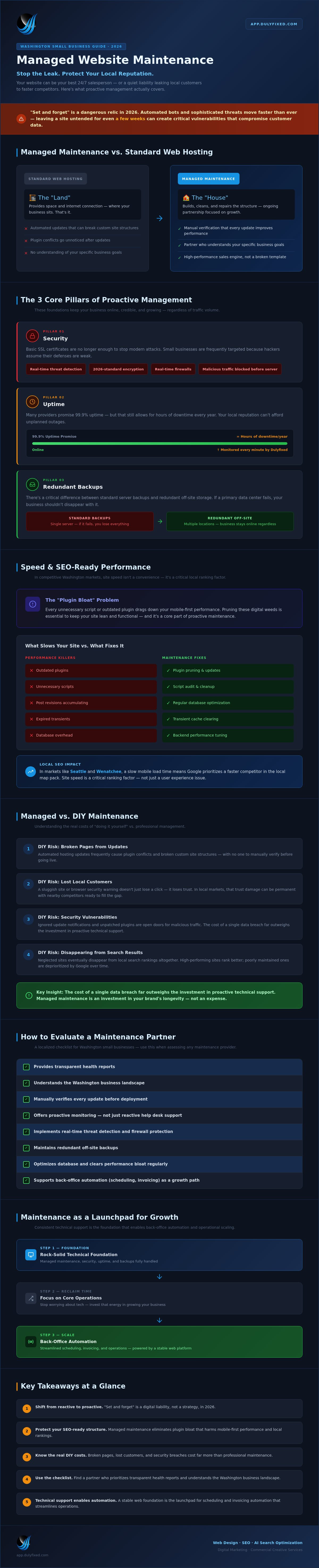
Managed website maintenance is a proactive strategy where a technical partner actively monitors, updates, and optimizes your digital presence before problems occur. It isn't a reactive help desk you call only when things break; it's an ongoing partnership focused on growth. In 2026, the "set and forget" approach is a dangerous relic. Automated bots and sophisticated security threats move faster than ever. Leaving a site untended for even a few weeks can lead to critical vulnerabilities that compromise your customer data.
For Washington businesses, your website is your 24/7 storefront. Whether you're operating out of Soap Lake or a busy metro area, local customers expect instant load times and impeccable security. If your site feels sluggish or triggers a browser warning, you don't just lose a click; you lose their trust. Site health is now directly tied to brand authority. High-performing sites rank better in local search, while neglected ones eventually disappear from the results altogether.
The Core Pillars of Proactive Management
True management focuses on three critical areas that keep your business online and credible. These pillars ensure your technical foundation remains stable regardless of how many visitors you attract.
- Security: Basic SSL certificates are no longer enough to stop modern attacks. We implement real-time threat detection to block malicious traffic before it ever reaches your server.
- Uptime: While many providers promise 99.9% uptime, that still allows for hours of downtime every year. We monitor your site every minute to ensure your local reputation stays intact.
- Redundant Backups: There's a major difference between standard server backups and redundant off-site storage. If a primary data center fails, your business shouldn't disappear with it.
Managed Maintenance vs. Standard Web Hosting
Think of managed web hosting as the "land" where your business sits. It provides the space and the connection to the internet. Maintenance is the work required to build, clean, and repair the "house" itself. Many business owners assume their host handles everything, but automated hosting updates often break custom site structures or cause plugin conflicts. A dedicated "fixer" understands your specific business goals and manually verifies that every update improves performance. This hands-on technical support ensures your site remains a high-performance sales engine rather than a broken template.
The Technical Anatomy: Security, Speed, and SEO-Ready Performance
High-performance websites are built on precise technical foundations. When we develop SEO-ready site structures, we create a blueprint for visibility. However, without consistent care, that structure begins to erode. One of the primary culprits is "plugin bloat." It's common for business owners to add new features over time, but every unnecessary script or outdated plugin drags down your mobile-first performance. Pruning these digital weeds is essential to keep your site lean and functional.
In competitive Washington markets like Seattle or Wenatchee, site speed isn't just a convenience. It's a critical ranking factor for the local map pack. If your page takes too long to load on a mobile device, Google will simply prioritize a faster competitor. Effective managed website maintenance involves regular database optimization, which is the hidden task that keeps your site snappy. By clearing out post revisions, expired transients, and database overhead, we ensure your backend remains as fast as the day it launched.
Security as a Local Business Asset
Small communities like Soap Lake aren't invisible to cyber threats. In fact, small businesses are often targeted because hackers assume their defenses are weak. Protecting customer data is a prerequisite for maintaining local trust. Adhering to cybersecurity best practices for small businesses is no longer optional. We implement 2026-standard encryption and real-time firewalls to block malicious traffic. The cost of a single data breach far outweighs the investment in proactive technical support.
Maintaining the Mobile-First Edge
Most of your local customers are searching for you while on the move. They might be using regional mobile networks with inconsistent bandwidth. Proactive managed website maintenance ensures your responsive elements don't break during CMS core updates. We optimize images and assets specifically for mobile users to guarantee a seamless experience. Keeping your mobile-first site speed at peak levels prevents visitors from bouncing back to the search results. If you aren't sure how your site currently stacks up, you can request a technical support review to identify performance bottlenecks.
Managed vs. DIY Maintenance: Finding the Right Balance
Small business owners often view website upkeep as a simple weekend task. You see a notification in your dashboard, click "update," and assume everything's fine. But DIY maintenance carries hidden costs that rarely appear on a balance sheet. Every hour you spend troubleshooting a broken layout or a white screen of death is an hour you aren't closing deals or managing your team. The lost opportunity cost of DIY often far exceeds the price of professional support.
There's a place for hands-on management. Handling simple blog updates, changing a team photo, or adjusting your office hours is perfectly appropriate for most owners. However, touching core files, database settings, or server configurations without a safety net is dangerous. The difference in response times is also stark. While a DIY "fix" might involve hours of searching through technical forums, managed website maintenance provides a direct line to a professional who can resolve issues in minutes.
The DIY Trap: Why 'One-Click Updates' Fail
Most DIY setups lack a staging environment. This is a separate, private copy of your site where updates are tested before they go live. Without it, a "one-click update" can trigger a conflict between your theme and a plugin, taking your site offline immediately. Major CMS releases frequently change how code interacts; if you miss a critical security patch because you're afraid of breaking the site, you leave the door open for automated exploits. Professionals use automated testing and manual verification to ensure your site remains stable during every update cycle.
The Managed Advantage: Expert Eyes on Your Brand
Transitioning to managed website maintenance turns a technical chore into a strategic advantage. Instead of paying emergency "fix-it" fees when something goes wrong, you benefit from predictable monthly costs and a partner who understands the intricacies of your landing page design. This expert oversight ensures that your site remains consistent with your brand identity while performing at peak levels.
You can explore different service tiers on the Dulyfixed Solutions page to see which level of support fits your current operations. Outsourcing these tasks provides more than just technical stability. It gives you the mental bandwidth to focus on core business growth while we handle the digital heavy lifting. By treating your website as a high-performance sales engine rather than a hobby, you ensure it continues to generate value for years to come.
How to Evaluate a Maintenance Partner: A Small Business Checklist
Choosing a provider for managed website maintenance is a high-stakes business decision. You need a partner who understands the specific nuances of the Washington market. A local expert recognizes that a business in Soap Lake has different visibility needs than a firm in downtown Seattle. They also ensure your site can scale as you grow from a local presence to a regional powerhouse. Beyond basic updates, look for technical depth that includes back-office automation to help streamline your daily operations and reduce manual data entry.
Transparency is another non-negotiable factor. Your maintenance partner should provide a clear, monthly health report that serves as a roadmap of your site's stability. This document shouldn't be a wall of tech jargon; it should highlight uptime, security scan results, and specific performance improvements made during the month. If you can't tell exactly what technical tasks were completed or how they benefit your bottom line, you're not getting true managed support. You're essentially paying a subscription for silence, which is a significant risk in a fast-moving digital economy.
The Essential 'Must-Have' Services
A professional plan covers more than just the backend of your site. It preserves your brand's image and keeps your sales engine running smoothly. Your partner should act as a proactive fixer, not just a reactive help desk.
- Real-time Monitoring: 24/7 oversight to catch server errors or security threats before your customers notice them.
- Performance Audits: Regular speed checks and core web vitals optimization to ensure your site remains competitive in search results.
- Content Support: Assistance with keeping your gallery or portfolio updated so your latest projects and best work are always on display.
Red Flags to Watch Out For
Identifying the right provider for managed website maintenance requires looking past the sales pitch and focusing on their technical execution. Be wary of providers who hide behind "black box" processes. If they can't explain how they protect your site or what specific security protocols they use, they probably aren't doing enough.
- Communication Gaps: Delayed responses to critical issues or vague answers to simple technical questions.
- Ignoring SEO: Maintenance plans that don't account for search rankings or mobile-first performance are incomplete.
- Integration Issues: An inability to provide technical support for your CRM, scheduling tools, or third-party APIs that keep your business running.
Scaling Your Operations with Integrated Support and Automation
A stable website isn't the end goal; it's the starting line. Effective managed website maintenance provides the structural integrity required to layer on complex back-office automation. When your site's core is secure and predictable, you can safely integrate scheduling tools, automated invoicing, and CRM systems that talk to each other without fear of a mid-update crash. This reduces operational friction, allowing you to move from manual data entry to a system that works while you sleep.
Looking toward 2026, the landscape of visibility is shifting. Maintenance now includes AI search optimization to ensure your brand remains discoverable on platforms like ChatGPT, Gemini, and Perplexity. It's no longer enough to rank on page one of Google; your site must be structured so AI agents can accurately parse and recommend your services. This evolution turns technical upkeep into a forward-looking growth strategy that keeps you ahead of competitors who are still stuck in 2024. Closing the loop between a healthy website and a streamlined business operation is the most effective way to scale.
From Maintenance to Growth
A well-maintained site is significantly easier to automate because the underlying code is clean and standardized. When we eliminate technical debt, we create a playground for efficiency. You can see how this works in practice by reviewing how automation improves efficiency in our recent case studies. Beyond the backend, modern maintenance also involves keeping your media assets fresh. Integrating digital video production into your regular update cycle ensures your site remains engaging and reflects your brand's current standards.
Your Next Steps for a Secure 2026
Start with a quick self-audit of your current digital health. Check your site speed on a mobile device using a regional network. Look for broken links or outdated copyright dates that signal neglect to potential customers. If your site feels like it's just "running" rather than "thriving," it's time to bridge that gap with professional oversight. Transitioning to managed website maintenance allows you to reclaim your time and focus on the high-level decisions that grow your Washington business. You can contact Dulyfixed for a maintenance assessment to identify exactly where your operations can be streamlined for the year ahead.
Future-Proof Your Digital Sales Engine
Your website is the most hardworking member of your team. In the 2026 digital landscape, keeping it healthy requires more than just reactive fixes. It demands a proactive strategy that integrates security, speed, and operational efficiency. By prioritizing managed website maintenance, you protect your local reputation and ensure your SEO-ready structure continues to drive traffic from across Washington.
We've explored how professional oversight eliminates the DIY trap and opens the door to powerful back-office automation. This transition allows you to stop fighting technical fires and start focusing on high-level business growth. Dulyfixed provides the local expertise and technical depth needed to turn your site into a streamlined business operation. Whether you're based in Soap Lake or scaling regionally, your technical foundation should be a reliable asset, not a nagging liability. You deserve the peace of mind that comes from knowing your site is optimized for both human visitors and AI search engines.
Secure Your Site with Dulyfixed Managed SupportIt's time to reclaim your time and build a more resilient brand. We look forward to helping you thrive in the year ahead.
Frequently Asked Questions
What is included in managed website maintenance?
Managed website maintenance includes core CMS updates, security monitoring, and regular database optimization. At Dulyfixed, we focus on preserving your SEO-ready site structure and ensuring mobile-first performance remains high. This service often extends to content support for your gallery and technical troubleshooting for third-party integrations. It is a comprehensive partnership designed to keep your digital storefront secure and fast for customers in Wenatchee and surrounding Washington communities.
Is managed hosting the same as website maintenance?
No, they are distinct services. Managed web hosting provides the server environment and basic security for your site to exist online. Website maintenance involves the active upkeep of the site's software, plugins, and custom code. While hosting keeps the lights on, maintenance ensures the building is safe, efficient, and modern. Dulyfixed offers both to provide a seamless technical foundation for small businesses operating from Soap Lake to Seattle.
How much does professional website maintenance cost for a small business?
Professional maintenance costs vary based on your site's complexity and the level of technical support required. A simple landing page requires fewer resources than a complex site integrated with back-office automation. While we avoid quoting flat industry prices, most Washington small businesses find that a monthly plan is significantly more affordable than paying emergency fees to fix a broken site. It's a strategic investment that protects your brand's long-term stability.
Can I do my own website maintenance to save money?
You can perform basic updates yourself, but it often leads to hidden costs in lost time and technical errors. One-click updates frequently cause conflicts between themes and plugins, which can take your site offline at critical moments. Small business owners in competitive markets like Moses Lake often find that outsourcing these tasks allows them to focus on core operations while ensuring their technical foundation remains rock-solid and secure for 2026.
Does website maintenance help with my local SEO rankings?
Yes, consistent maintenance is a prerequisite for SEO success. Search engines prioritize sites that are fast, secure, and mobile-friendly. Regular managed website maintenance ensures your site meets these core web vitals consistently. By optimizing your database and pruning plugin bloat, you maintain the high-speed performance needed to rank in local search results across Ephrata and Wenatchee. This turns your site into a high-performance sales engine that attracts local customers.
How often should website maintenance be performed?
Maintenance should be an ongoing process rather than a sporadic task. While security monitoring happens in real-time, technical audits and plugin updates are typically performed weekly or monthly. This frequency ensures your site stays ahead of new security vulnerabilities and performance bottlenecks. Consistent oversight prevents small technical glitches from snowballing into major site failures that could alienate your local customers and damage your brand's digital reputation in a crowded market.
What happens if I don't maintain my small business website?
Neglecting your site leads to several critical risks. Your site will likely slow down over time, causing visitors to bounce to faster competitors. You also become a prime target for automated hacking attempts that exploit outdated software. Eventually, your search rankings will drop as the site fails to meet modern mobile-first standards. In Washington's competitive markets, an unmaintained site quickly transitions from a valuable business asset to a quiet, expensive liability.
Do you provide technical support for sites you didn't build?
Yes, Dulyfixed provides technical support for websites built by other developers. We begin with a comprehensive technical audit to identify existing vulnerabilities or performance issues. Once we understand your current site structure, we can implement a managed website maintenance plan that aligns with your business goals. This allows you to benefit from our local expertise and back-office automation services regardless of who originally designed or launched your digital presence.
Talk With Dulyfixed
If this article connects with something you are trying to improve, send a note about your website, marketing, search visibility, or AI discovery goals.