
Published September 9, 2026
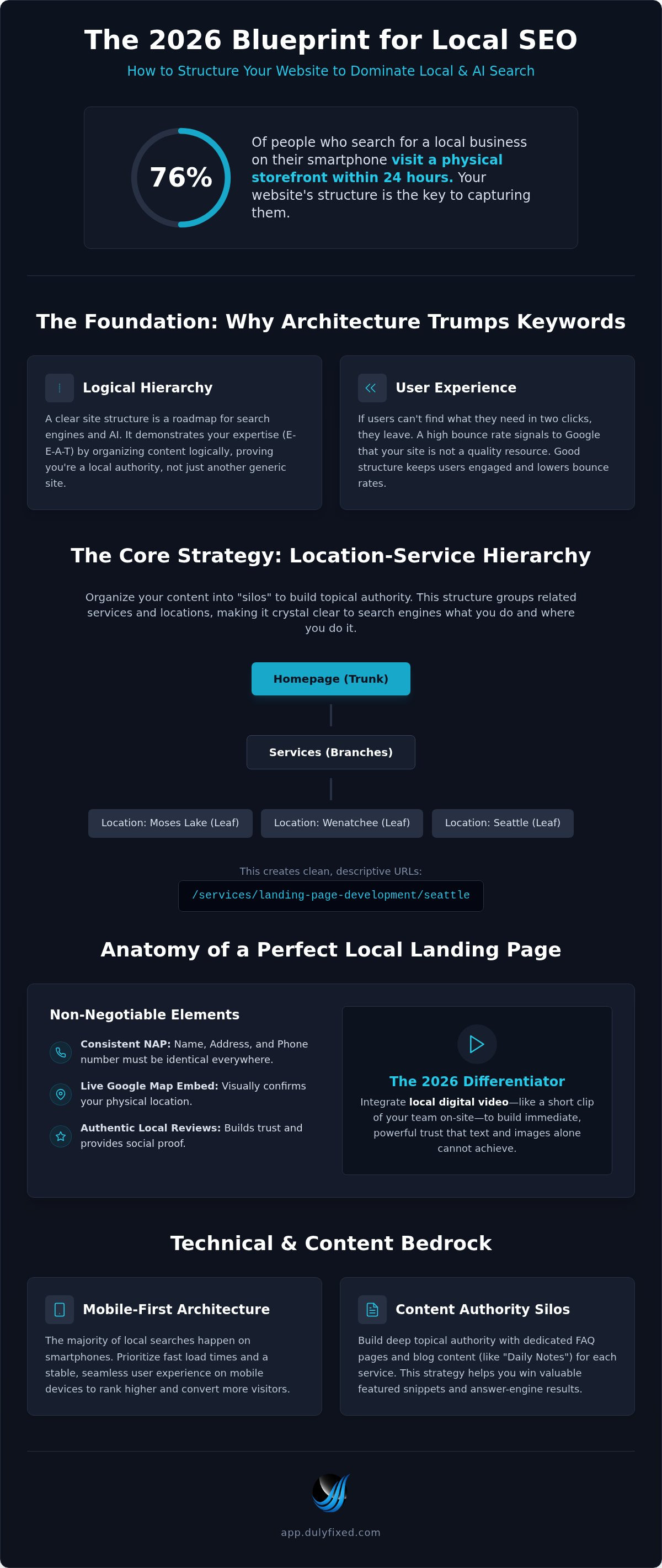
Did you know that 76% of people who search for a local business on their smartphone visit a physical storefront within 24 hours? You already know that showing up when someone searches "near me" is the lifeblood of your company. Yet, it's incredibly frustrating to watch competitors in Moses Lake, Wenatchee, or Seattle grab all the leads because your site feels slow, disorganized, or technically outdated. If terms like schema and siloing feel more like obstacles than tools, you aren't alone.
This guide will show you exactly how to structure a website for local SEO to dominate both traditional search results and the AI answer engines that now define 2026. I've spent years refining these frameworks to ensure small businesses don't just exist online; they perform. You'll learn how to build a mobile-first architecture that prioritizes speed and clarity. We'll move past the fluff and dive straight into a pragmatic blueprint that turns your website into a high-converting local asset that search engines trust and customers actually want to use.
Key Takeaways
- Learn why a logical hierarchy is the primary way AI answer engines and search bots interpret your business's relevance in 2026.
- Discover how to structure a website for local SEO by mapping dedicated service pages to specific Washington markets like Moses Lake and Wenatchee.
- Master the technical requirements for a mobile-first architecture that prioritizes fast load times and stable user experiences on smartphones.
- Identify the specific content silos, including FAQ pages and "Daily Notes," needed to build local topical authority and win featured snippets.
- See how back-office automation and managed hosting keep your site data fresh and accurate across all local listing platforms.
Table of Contents
- The Foundation of Local SEO Structure: Why Architecture Trumps Keywords
- Designing a Location-Service Hierarchy for Washington State Markets
- Mobile-First Technical Architecture: The Local Ranking Bedrock
- Content Architecture: Trust Signals and Local Video Integration
- Future-Proofing Your Structure with Automation and Managed Support
The Foundation of Local SEO Structure: Why Architecture Trumps Keywords
Think of your site structure as the organizational map of your entire digital presence. It isn't just about where buttons go; it's about how you categorize information to prove relevance. When you're learning local search engine optimization, you'll find that structure often outweighs individual keywords. A site with perfect keywords but a messy layout will fail because search engines can't verify your expertise. If a user in Seattle can't find your service page within two clicks, they'll leave. This creates a high bounce rate, which tells search engines your site isn't a quality resource.
In 2026, AI engines like ChatGPT and Gemini don't just read pages. They analyze how those pages relate to each other. A clear hierarchy tells these engines that you aren't just a generic service provider, but a local authority. This organization builds E-E-A-T (Experience, Expertise, Authoritativeness, and Trust). By prioritizing a human-first layout, you ensure that visitors find what they need quickly, which naturally improves your rankings over time.
What is a Local SEO Silo?
A silo is a method of grouping related content to build topical authority. Instead of a flat structure where every page is just one click from the home page, a hierarchical approach organizes services logically. For instance, if you offer digital marketing in Moses Lake and video production in Seattle, those should live in distinct service-location silos. This organization helps you rank for specific "near me" searches because it clarifies your geographic footprint. Properly grouped content proves to Google that you have deep knowledge in a specific niche and region.
Why 2026 Search Engines Demand Structure
Generative Engine Optimization (GEO) is the new standard for digital visibility. To be cited by an AI answer engine, your site needs structured data and clean navigation. These tools look for patterns to determine which business to recommend in a voice or text query. Site structure serves as a roadmap for search crawlers. At Dulyfixed, we build SEO-ready site structures that provide the technical stability needed for AI engines to index your data accurately. Without this foundation, your content remains invisible to the very tools customers use to find local help.
Designing a Location-Service Hierarchy for Washington State Markets
Mapping your core service areas is the first step in building a site that actually converts. If you operate in Soap Lake, Ephrata, or Moses Lake, your website must reflect that geography through a logical hierarchy. You can't just list cities in a footer and expect to rank. Instead, you need to create a structure where your primary service pages link directly to dedicated location landing pages. This creates a clear path for both users and search crawlers to follow. When considering how to structure a website for local SEO, think of it as a tree. Your homepage is the trunk, services are the branches, and specific cities are the leaves.
A logical URL structure is the backbone of this system. For example, using a path like /services/landing-page-development/seattle tells Google exactly what you do and where you do it. This organization allows you to pass internal link juice from your high-authority homepage down into these specific local silos. To ground these pages in reality, integrate local entities like regional landmarks or links to local governing bodies. This proves to AI engines that your business is a legitimate part of the Central Washington community.
Building the Perfect Local Landing Page
Every local page needs three non-negotiable elements: a consistent Name, Address, and Phone number (NAP), a live Google Map embed, and authentic local reviews. These signals verify your physical presence. To stand out in 2026, we also recommend integrating local digital video. A short clip of your team working in Wenatchee or Seattle builds immediate trust that text alone cannot achieve. If you need help creating these high-performance assets, explore our Professional Landing Page Design Services in Soap Lake & Seattle to see how we blend technical SEO with modern creative tools.
The Role of Service-Area Pages
Contractors in Moses Lake and Wenatchee often struggle with the choice between a single "Areas Served" page and individual city pages. If you have a physical office in each city, individual pages are a must. If you're a mobile service provider, start with a comprehensive areas page but build out city-specific pages for your top-performing markets. To avoid duplicate content penalties, ensure each page has unique text about local projects or specific neighborhood needs. Dulyfixed prioritizes mobile-first landing pages for these sections because most local searches happen on the go. If your local hierarchy feels disorganized, it might be time to reach out for a structural audit to ensure you aren't leaking potential leads to your competitors.
Mobile-First Technical Architecture: The Local Ranking Bedrock
Local search is effectively mobile search. With 90% of local queries happening on smartphones, your technical foundation must prioritize the handheld experience above all else. When users search for services "near me" while driving through Moses Lake or walking in downtown Seattle, they expect immediate results. If your site doesn't load instantly, they'll bounce back to the search results before your logo even appears. Understanding how to structure a website for local SEO requires a deep dive into these technical performance metrics.
Core Web Vitals are now direct ranking factors. Google measures how quickly your content loads and how stable the layout remains as it renders. In rural areas like Soap Lake or Ephrata, where mobile data speeds can be inconsistent, high-performance architecture is your biggest competitive advantage. While adaptive design was once popular for its specific device targeting, responsive design is the 2026 standard. It provides a single, fluid codebase that is easier for search engines to crawl and more reliable for users across every possible screen size.
Speed Optimization and Managed Hosting
Generic, budget hosting is a silent killer for local businesses. These shared environments often suffer from high latency and slow server response times, which directly tank your local rankings. Managed hosting provides a stable, optimized environment specifically tuned for speed and security. It ensures your site remains online and fast during peak traffic hours. For businesses that can't afford technical downtime, we offer Managed Hosting and Technical Support to handle the heavy lifting of server maintenance and speed optimization. This allows your site to maintain the high-speed performance that both users and AI answer engines demand.
Technical SEO Checklist for Local Sites
A fast site is only half the battle; it must also be technically legible to search bots. Your structure needs to include specific markers that define your local relevance. Focus on these three pillars to ensure your technical SEO is future-proof:
- Local Business Schema: Use JSON-LD to provide search engines with your exact coordinates, operating hours, and service categories. This structured data is what populates the "knowledge panels" and AI summaries that customers see first.
- Voice Search Optimization: Structure your content with conversational H3 headings. People don't type "plumber Moses Lake"; they ask their phone, "Who is the best plumber near me?" Your headings should answer these natural questions directly.
- Security and Resolution: Ensure your site uses secure HTTPS protocols and fast DNS resolution. These are baseline trust signals that prevent browsers from flagging your site as "not secure," which is a death sentence for local conversion rates.
Content Architecture: Trust Signals and Local Video Integration
Content is only as effective as the structure that supports it. To build genuine local authority, you need to organize your information so search engines see you as a reliable community resource. One of the most effective ways to do this is through a dedicated "Daily Notes" or blog section. By posting regular updates about local projects or community events, you signal "freshness" to search crawlers. This ongoing activity proves that your business is active and engaged in your specific service area, which is a key differentiator in 2026.
FAQ pages also play a critical structural role. Instead of burying answers in long paragraphs, use a dedicated FAQ silo to address common customer concerns directly. This organization makes it easier for AI answer engines to find and cite your content as the definitive answer for local queries. This strategy is a core component of how to structure a website for local SEO because it targets "zero-click" searches and featured snippets where your business can appear above the standard organic results.
Leveraging Video for Local Engagement
For service providers in Wenatchee or Moses Lake, digital video is the ultimate trust signal. It humanizes your brand and provides visual proof of your expertise. Integrating video into your site structure does more than just look good; it significantly increases "time on page" or dwell time. To ensure Google can actually find this content, you must implement a video sitemap. This technical step allows search engines to index your commercial creative work properly, giving you an edge in both video search and standard local results. You can see these principles in action by exploring our guide on Social Media Video Production: High-Impact Examples and Strategies for 2026.
Content Siloing for Diverse Services
If your business offers diverse services, such as Web Design and Custom Music, you must separate them into distinct silos. Mixing these topics on a single page confuses search engines and dilutes your topical authority. Use internal breadcrumbs to help users and bots navigate between these silos without getting lost. A well-organized Gallery provides the visual proof customers need to verify your work across different service lines. By keeping your testimonials and project photos categorized by service and location, you create a high-converting environment that guides the visitor toward a final decision.
Start building your local authority todayFuture-Proofing Your Structure with Automation and Managed Support
A static website is a dying asset in 2026. If your site just sits there without updates, it's losing ground to more dynamic competitors every day. Modern local SEO isn't just about what you said two years ago; it's about real-time accuracy and functional utility. When you understand how to structure a website for local SEO, you realize that your site must be a living document. Search engines now prioritize platforms that prove they are active through consistent data updates and high user engagement. If your business hours or service areas change and your site doesn't reflect that immediately across all platforms, you're signaling to AI engines that your information is unreliable.
Back-office automation is the secret weapon for maintaining this consistency. By automating the sync between your site data and local listings, you ensure that potential customers in Seattle or Moses Lake always see accurate information. This operational efficiency is a critical part of how to structure a website for local SEO because it prevents the structural decay that often plagues older sites. Managed maintenance keeps your internal links healthy and your page speeds high, ensuring your architectural blueprint remains solid as search algorithms evolve. This proactive approach stops technical debt from piling up and protects your ranking from sudden drops.
Integrating Automation into the User Journey
Conversion is the ultimate goal of any SEO strategy. Automated tools like online scheduling and instant invoicing do more than just save you time; they improve the user path. When a visitor finds your site and can book a service immediately, their engagement signal is incredibly strong. Search engines track these successful interactions and reward sites that provide a seamless functional journey. To keep your site running at peak performance, follow our Website Maintenance Wenatchee Checklist for a clear path to technical health.
The Dulyfixed Advantage: Beyond Basic Design
At Dulyfixed, we don't just build websites; we build growth engines. We combine mobile-first design with an SEO-ready site structure and back-office automation to ensure your business stays ahead of the curve. This integrated approach means your site is ready for traditional search, AI answer engines, and the high expectations of modern local customers. We focus on long-term technical stability so you can focus on running your organization. If you're ready to move beyond temporary fixes, visit our Solutions page to explore a tailored plan for your business. We are here to audit your current structure and help you build a blueprint that dominates the local market.
Dominating Local Search Through Architectural Excellence
The 2026 search landscape requires more than just a list of keywords. You've seen how a mobile-first, siloed hierarchy turns a disorganized site into a high-performing lead generator. By mastering how to structure a website for local SEO, you ensure that both human visitors and AI answer engines can verify your expertise in markets like Moses Lake, Wenatchee, and Seattle. This organization is what separates a business that just exists from one that actually dominates its region.
Success comes down to technical stability and local relevance. Implementing structured data, optimizing for voice search, and integrating digital video builds the trust signals necessary to convert traffic into long-term customers. As a mobile-first design specialist with deep roots in Washington State, I know that your digital foundation must be built for speed and clarity. We provide the managed hosting and technical support you need to keep your site fast and functional as search algorithms evolve.
Ready to fix your local search visibility? Contact Dulyfixed today for an SEO-ready site structure.Your website should be your hardest-working employee. Building it on a pragmatic, future-proof blueprint is the most effective way to secure your growth and technical stability. Let's get to work.
Frequently Asked Questions
What is the most important part of a local website structure?
The most important element is your location-service hierarchy. This organizational map tells search engines exactly what you do and where you do it. By grouping services into specific silos for cities like Moses Lake or Seattle, you build topical authority. This prevents a flat site structure that confuses crawlers and helps you rank for high-intent queries.
Do I really need a separate page for every city like Ephrata and Moses Lake?
Yes, dedicated landing pages for your primary markets are essential. These pages allow you to integrate local landmarks and reviews specific to that community. When you learn how to structure a website for local SEO, you'll see that city-specific pages are the best way to capture "near me" traffic without triggering duplicate content penalties.
How does mobile-first design impact my local SEO rankings?
Mobile-first design is the primary ranking factor for local search in 2026. Since most local queries happen on smartphones, Google prioritizes sites that load fast and function perfectly on mobile devices. If your site isn't mobile-first, you'll likely fail Core Web Vitals tests. This leads to lower visibility in competitive Washington State markets.
What is Local Business Schema and do I need it?
Local Business Schema is structured data code that identifies your business name, address, and phone number for search engines. You absolutely need it to appear in the Google Local Pack and AI answer engines. Dulyfixed includes this JSON-LD code in every SEO-ready site structure to ensure your technical data is clear and authoritative.
How often should I update my website structure?
You should audit your structure annually, but update it whenever you expand services or target new areas like Wenatchee. Regular updates prevent structural decay and broken links. Using back-office automation can help keep your site data current. This ensures search engines always have the most recent information about your local operations.
Can video content actually help my website rank higher in local search?
Video content significantly boosts your rankings by increasing the time visitors spend on your page. It serves as a powerful trust signal for local customers. When you include a video sitemap, search engines can index your digital video production. This helps your business appear in both standard search results and specialized video carousels.
What is the difference between a landing page and a regular website page for SEO?
A landing page is built for a single conversion goal, such as booking a service in Soap Lake. Regular pages are often broader and informational. SEO-ready landing pages are stripped of distractions and focused on high-intent keywords. This structure makes them much more effective at turning local searchers into actual paying customers.
Why should I choose managed hosting over a cheap generic provider?
Managed hosting provides the speed and technical stability that generic providers lack. Local SEO requires fast server response times to pass mobile performance audits. Cheap hosting often results in high latency and frequent downtime. Dulyfixed offers managed hosting to ensure your site remains secure, high-performing, and ready to handle local traffic surges.
Talk With Dulyfixed
If this article connects with something you are trying to improve, send a note about your website, marketing, search visibility, or AI discovery goals.