
Published November 26, 2026
A broad service list doesn’t automatically make an agency the right fit. Knowing how to choose a web design agency means judging whether its proposed work matches your business priorities, not simply counting platforms or services. You may prefer one partner to coordinate a project, or a specialist focused on a defined need. The better fit depends on your project scope and the support you want from the agency.
This guide explains how to compare proposals and weigh platform expertise against broader services. It also helps you assess the roles of design and development in your project, and whether one provider can handle the work you need. Clarify your priorities before comparing recommendations, so you can choose a partner whose approach fits your business and the website you want to build.
Key Takeaways
- Match platform expertise to your project’s needs, then review relevant portfolio work and the agency’s approach to user experience and SEO.
- Compare proposals by scope, process, communication, and post-launch support, not just by the services listed.
- Choose a specialist for a focused need or consider a full-service agency when the project calls for several disciplines.
- Use website reviews, competitor comparisons, or SEO gap reports to clarify what your site needs before deciding on design or redesign work.
1. Should I choose an agency based on platform expertise (WordPress, Webflow, etc.)?
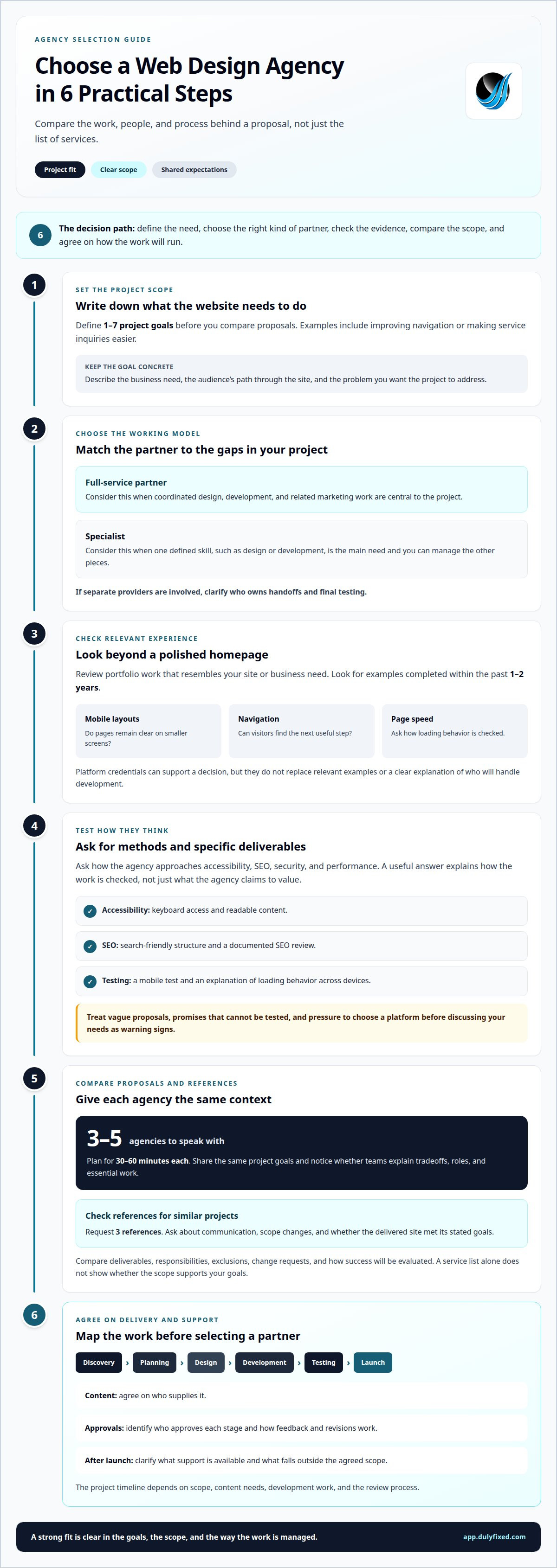
Choose platform expertise when your project depends on a specific system, such as a Webflow marketing site or a WordPress content workflow. Ask which credentials or platform partnerships apply, what they demonstrate, and who will handle development. When deciding how to choose a web design agency, treat credentials as supporting evidence, not a substitute for relevant experience and clear project examples.
Review the agency’s portfolio for sites like yours, such as a small-business service site or an online store. Look for work completed within the past 1-2 years, then assess mobile layouts, clear navigation, and page speed. A polished homepage alone won’t show whether the agency can shape a useful path from landing page to contact form.
Ask what accessibility, SEO, security, and performance standards guide the work. A capable agency should explain how it checks keyboard access, content readability, search-friendly structure, software updates, and loading behavior across devices. Request concrete deliverables, such as a mobile test or documented SEO review, rather than relying on broad claims.
Ask which platform suits your content and team, how the agency plans navigation, and how it handles technical SEO. Clarify who approves designs, how revisions work, and what support is available after launch. These questions make choosing a web design agency more practical than relying on platform familiarity alone.
To verify reviews, references, and results, compare client testimonials with detailed case studies and request 3 references for similar projects. Ask each reference about communication, scope changes, and whether the delivered site met its stated goals. Check that reported outcomes connect to the agency’s actual work.
Watch for vague proposals, promises that cannot be tested, or pressure to choose a platform before discussing your needs. If an agency cannot explain its user experience decisions, SEO approach, or testing process in plain language, its portfolio may not tell the whole story.
2. Should I choose a full-service agency or specialist?
A web design agency focuses on site structure, visual design, and the customer journey. A development-focused team handles the technical build, such as custom features or connections between systems. A full-service agency may combine design, development, and related marketing work. Choose the model that addresses the actual gaps in your project, not the one with the longest service list.
For example, a small business refreshing its service pages may need design and development, while a complex site with custom workflows may need deeper engineering. A full-service partner can coordinate several disciplines through one process. A specialist may bring more focused expertise when the goal is narrowly technical or design-focused.
Local versus remote is a working-style decision. A local agency can make in-person collaboration easier when meetings matter to your team. A remote agency can also work well if it provides clear communication, shared approvals, and scheduled reviews. Prioritize those practical arrangements over location alone.
There is no single standard price for a website project in the United States. Scope, custom functionality, content needs, integrations, and ongoing support all affect a proposal. Before comparing totals, check what each quote includes, excludes, and treats as a change request.
A useful process moves through discovery, planning, design, development, and testing before launch. Agree on who supplies content, who approves each stage, and how feedback is handled. The project timeline depends on its scope, content needs, development work, and review process.
Allow time to assess the scope before selecting a partner. If you need help clarifying the work or comparing possible approaches, discuss your website project.
3. Full-service agencies versus specialists
A full-service agency can coordinate several parts of a website project, such as design, development, and search planning. That can help when your business needs a connected path from discovery to conversion. The tradeoff is that a broad scope can make it harder to see which work matters most. Define 1-7 project goals before comparing proposals, such as improving navigation or making service inquiries easier.
A specialist is a stronger fit when the main challenge is clear and narrow. For example, a development specialist may suit a site that needs a custom feature, while a design specialist may focus on a confusing customer journey. If the work crosses disciplines, clarify who owns handoffs and final testing when coordinating separate providers.
Compare proposals by deliverables, not labels. Check whether the scope connects design decisions to business goals, identifies technical responsibilities, and explains how success will be evaluated. For a lead-generation site, ask how page structure and calls to action support conversion. A list of services without a clear connection to your goals may leave important work out.
Use discovery conversations to test the fit. Speak with 3-5 agencies for 30-60 minutes each, and give every team the same project goals and context. Notice whether they identify tradeoffs, explain their roles, and distinguish essential work from optional additions. Their questions can reveal whether they understand the full customer journey or only one part.
Choose a full-service partner when coordinated disciplines are central to the project. Choose a specialist when one defined skill is the main need and you can manage the other pieces. This distinction helps you compare proposals based on fit, accountability, and the work needed to launch.
Get It DulyfixedDulyfixed Small Business Solutions: Website Design, Redesigns and Landing Pages
Dulyfixed Small Business Solutions helps businesses turn project goals into a practical website scope. Its website design, redesign, and landing page services can support a new site, an outdated customer journey, or a focused offer for businesses in Soap Lake, Washington, and Moses Lake, Washington.
For stronger visibility planning, consider Local and National SEO and AI Discovery and Structured Data Optimization alongside your site structure. A website review, competitor comparison, or SEO gap report can help identify issues before you choose a redesign. This can help businesses in Soap Lake and Moses Lake decide whether their current site needs focused improvements or a broader change.
Bring your business goals, target audience, and current site concerns into the conversation. Contact Dulyfixed Small Business Solutions to discuss a next step.
Turn your website decision into a clear next step
Connect your website project to a business priority. Decide whether the immediate need is a new site, a focused landing page, stronger search visibility, or a clearer path for customers. This gives each proposal a practical measure of fit and helps you decide whether the project needs coordinated services or a narrower scope.
A thoughtful approach to how to choose a web design agency keeps the focus on work that supports your goals. Dulyfixed Small Business Solutions offers Website Design, Redesigns and Landing Pages, Local and National SEO, and AI Discovery and Structured Data Optimization. These services can help align your site and its visibility with your business needs.
Get It DulyfixedMake your next website decision clear and focused, with your business priorities at the center.
Frequently Asked Questions
How do I compare web design agency proposals?
Compare proposals against the same project brief, then examine assumptions and exclusions. Check whether each scope covers content entry, redirects from old pages, form testing, and team training. Ask how requested changes affect the scope. This makes differences clearer than comparing totals alone, especially for businesses coordinating a website project across Washington.
How do I evaluate a web design agency's portfolio?
Use a portfolio to assess how well an agency solves problems, not just how polished its visuals look. Choose a relevant example and try a real visitor task, such as finding a service detail or submitting an inquiry on a phone. Notice whether the page makes the next step clear. Ask which parts the agency handled and what the project involved.
How important are industry awards when choosing an agency?
Awards can offer context, but should not outweigh relevant work and a clear project process. Check which category an award recognizes and whether it relates to your needs, such as accessibility, visual design, or technical development. An award for a different type of work may say little about your project. Treat it as supporting information, not proof of fit.
How long should the agency selection process take?
A thorough agency selection process can take 4-8 weeks. Use that time to define the project scope, compare proposals, and discuss how each team would handle key decisions. The pace often depends on how quickly your business can gather requirements and review responses. A planned selection window can help maintain momentum without rushing a complex decision.
Should I choose a full-service agency or specialist?
Choose based on how much coordination your business can manage. A specialist may suit a tightly defined need, such as improving one part of a website. A full-service agency may fit a project where design, development, and related work need to move together. For a Washington business with several decision-makers, clarify who will coordinate feedback and resolve conflicting priorities.
Website design and landing pages
Plan pages around the information visitors need and the action they want to take.