

Published September 27, 2026
- Benefits of custom web design
- Structure, mobile use, and SEO
- Compare design providers
- Prepare for your project
- Plan for after launch
A beautiful website can still be a poor business tool. Investing in custom website design Seattle businesses can use to attract inquiries means looking beyond colors and layout. Your site should help customers understand what you offer, find the details they need, and take a clear next step.
Itâs reasonable to weigh a custom site against a template or a focused landing page. Youâll also want to know whether the finished design will work well on phones, make information easy to find through search, and load efficiently. Those details affect how useful your site is, not just how it looks.
This guide offers a practical way to evaluate design partners and plan a site around your customers and business goals. Youâll learn how to assess mobile usability and SEO structure, compare common site approaches, and clarify hosting, technical support, and ongoing needs. The goal is a site built to serve your business, not simply fill a screen.
Key Takeaways
- Choose custom website design Seattle based on your business goals, customer needs, and the work your site must support.
- Compare custom sites, templates, and landing pages to find the right fit for your content and customer journey.
- Assess navigation, mobile usability, and SEO structure by asking how customers will find information and get in touch.
- Before hiring a provider, clarify the project scope, process, ownership of key assets, and support after launch.
- Prepare service details, brand materials, contact information, and examples of useful site experiences to make planning more focused.
Table of Contents
- Benefits of Custom Web Design for Seattle Small Businesses
- How Seattle Custom Website Design Connects Structure, Mobile Use, and SEO
- How to Compare Custom Website Design Providers in Seattle
- How to Prepare for a Custom Website Project in Seattle
- Choosing a Seattle Website Design Partner for the Work After Launch
Benefits of Custom Web Design for Seattle Small Businesses
Custom website design plans and builds a site around a businessâs customers, goals, content, and workflows rather than starting with a fixed, ready-made layout. That planning shapes what visitors see first, how they move between pages, and how they contact the business. As the broader field of web design shows, a site involves more than visual style. Structure and usability matter too.
For a Seattle small business, the right choice depends on what the site needs to do. A custom site can support distinct services, useful location information, and customer tasks that donât fit a standard layout. A template may be a sensible starting point when the content and structure are straightforward. Neither option is automatically best. Match the build to your needs and your capacity to manage it.
Custom website, template, or landing page: what is the difference?
A template-based site uses a predesigned structure adapted with your content, images, and branding. It can simplify setup, but the available layouts and content patterns may limit how the site grows. A custom website involves planning around your pages and workflows, offering more flexibility while requiring clear decisions about scope, content, and future changes.
A landing page serves a narrower purpose. It focuses attention on one service, offer, or campaign and guides visitors toward a specific action. It may work alongside a larger site, or on its own when a focused page fits the goal. Explore landing page development services as a related option.
Start with what Seattle customers need to do
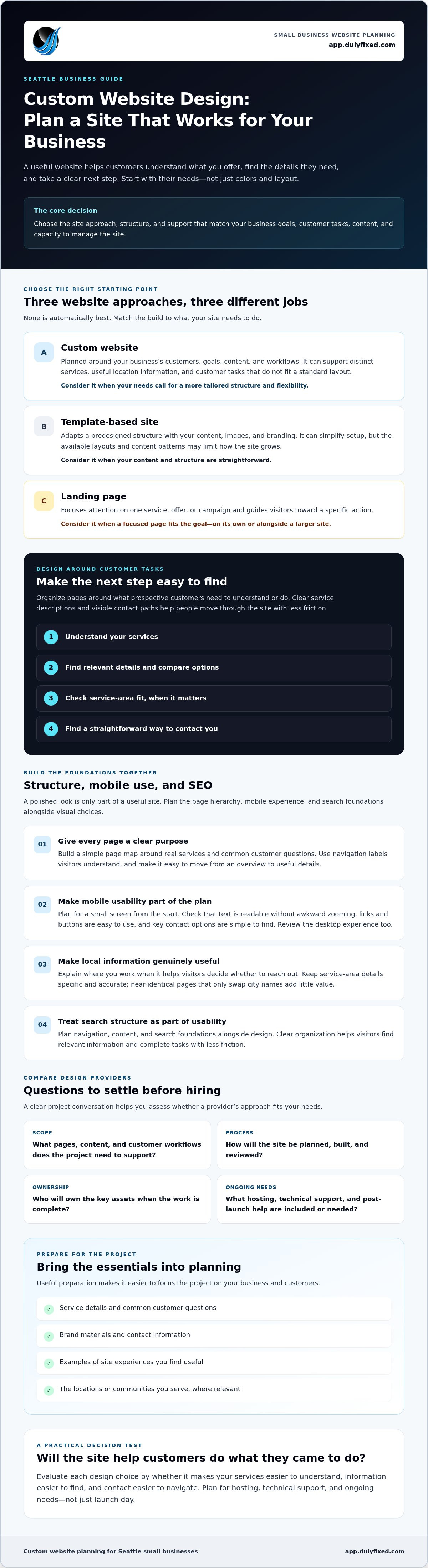
Before choosing layouts or colors, list the questions a prospective customer may bring to your site. They might need to understand your services, check whether you serve their area, compare options, or find a straightforward way to contact you. Organize pages around these tasks, with clear service descriptions and contact paths that are easy to spot.
Let local intent guide useful information rather than repeating city names. Explain where you work and which locations or communities you serve when that helps a visitor decide whether to reach out. For custom website design Seattle businesses can put to practical use, judge each design choice by whether it helps customers find the right information and take the next step.
How Seattle Custom Website Design Connects Structure, Mobile Use, and SEO
A site can look polished and still make basic tasks difficult. Visitors need to understand what you offer, find the right page, and know what to do next. Clear page structure and mobile usability help visitors find relevant information and complete tasks with less friction. Thatâs why custom website design Seattle projects should account for navigation, content, and search foundations alongside visual choices.
Plan pages around services, locations, and customer questions
Start with the information a prospective customer needs before making contact. Build a simple page map around your real services and common questions, such as what a service includes, how to get started, or whether you work in a particular area. Use navigation labels visitors understand, and give each page a clear purpose. A logical hierarchy helps people move from a broad overview to the details they need.
Include Seattle or other service-area details where they help someone assess fit. A useful service-area page explains where you work and what visitors can expect. Near-identical pages that only swap city names add little value and can make the site harder to use. Keep local content specific, accurate, and helpful.
Make mobile usability and search foundations part of the build
Mobile-first design means planning for a small screen from the start, not simply shrinking a desktop layout. Check that text is readable without awkward zooming, buttons and links are easy to use, and key contact options are simple to find. Then review the desktop experience too, especially on pages where visitors need to compare details or read longer information.
Search-ready structure supports both people and search engines. Use descriptive page titles, clear headings, meaningful internal links, and a page hierarchy that reflects your services. These foundations can make content easier to understand and maintain, but they donât guarantee rankings or traffic. Core Web Vitals are performance signals related to loading, interactivity, and visual stability. Reviewing them can help identify experience issues, but no single score tells the whole story.
After launch, Google Search Console can help you review how your pages appear in Google Search and identify search-related issues. Treat it as a monitoring tool, not a promise of results. Your site plan should also connect to business priorities. The SBA Business Guide offers broader planning resources that can help you clarify the goals your website needs to support.
If youâre mapping a site around your services and customer needs, you can discuss your website goals with Dulyfixed.
Custom Website Design Seattle: How to Compare Providers
A strong portfolio can show visual range, but it wonât tell you whether a providerâs process fits your business. Compare the work behind the mockups: how the provider defines scope, plans content, checks mobile behavior, handles SEO foundations, and supports the site after launch. For custom website design Seattle businesses can rely on, clear answers matter as much as an attractive design.
Questions to ask before choosing a web design partner
Ask what happens from discovery through launch. Who helps plan the content? How many design reviews and revisions are included? What testing happens before the site goes live? Ask the provider to explain design decisions in terms of your customersâ needs and business goals, not just personal taste.
Clarify which pages, features, and post-launch tasks are included in the proposed scope. If a detail is unclear, get it defined before work begins. This makes proposals easier to compare fairly.
Evaluate performance, SEO, and ownership, not just mockups
Ask how the provider checks mobile layouts, loading performance, accessibility considerations, and search basics during the project. Clarify who controls the domain, website files, content, hosting account, and administrative access after launch. Find out who handles future updates and what technical support, if any, is included. These details shape your ability to manage the site over time.
Hosting and technical support may be part of a connected service arrangement, but confirm the exact responsibilities and deliverables for your project. Dulyfixed lists web and technical services, so review the scope that applies to a specific engagement.
A custom build and a template-based site can both be appropriate. Compare them against your needs, flexibility requirements, and available time and resources:
| Consideration | Custom build | Template-based site |
|---|---|---|
| Structure | Planned around specific content and workflows | Uses an existing layout adapted to your content |
| Flexibility | Can accommodate more tailored requirements | Works within the templateâs available options |
| Best fit | Distinct needs or plans for a more tailored site | Straightforward needs and a preference for a ready-made structure |
| Key question | Can you define the scope and manage future changes? | Does the template support the pages and tasks you need? |
Use this framework to compare proposals, not to assume one approach is automatically superior. Choose the option whose scope, process, and ongoing responsibilities you understand before you commit.
How to Prepare for a Custom Website Project in Seattle
A focused brief helps you compare proposals and keep a website project tied to real business needs. You donât need every detail decided before the first conversation. Start with the essentials, then use provider discussions to clarify options, responsibilities, and scope. Preparation is especially useful when considering custom website design Seattle businesses can manage and build on over time.
Build a practical brief before requesting proposals
Write down who the site needs to serve, what your business offers, where you work, and what you want visitors to do. Then outline the pages and tools that may be needed. Separate launch essentials from ideas that could wait for a later phase. This gives providers a clear basis for discussing the project without committing you to features you may not need.
Before your first design discussion, prepare:
- Your primary audience, core services, service area, and the main action visitors should take.
- Current service descriptions, brand assets, accurate contact details, and existing website content.
- A rough page list, known integrations, and operational constraints, such as who can approve content.
- Examples of site experiences you find clear or useful, with a note about what works for you.
- A short list of launch priorities and features that can wait.
This checklist is a starting point, not a mandatory set of deliverables. Youâre ready to request proposals when you can explain the siteâs purpose, identify who will provide or approve key materials, and describe what needs more discussion.
Plan for content, launch, and ongoing care
Decide who will write or review service information, provide photos or other brand materials, confirm contact details, and approve pages. Accurate content takes coordination, so identify the people responsible early. Ask each provider how they handle testing and launch checks, and clarify who manages hosting, security maintenance, technical support, and updates afterward. Confirm which responsibilities are included rather than assuming they come with the build.
If your preferred provider isnât based in Seattle, distance alone doesnât determine whether the working relationship will fit. Dulyfixed Small Business Solutions is based in Soap Lake, Washington, and lists Seattle among its service locations. Ask any out-of-city provider how communication, review rounds, approvals, and support will work for your project, then confirm the details in writing.
Discuss your website projectChoosing a Seattle Website Design Partner for the Work After Launch
A website launch is a handoff, not the end of the project. Business details change, content needs updates, and performance should be reviewed so you can decide what to improve next. Before choosing a partner, understand who handles those tasks and how youâll work together once the site is live.
An out-of-city provider can still be a practical fit if communication and responsibilities are clear. Dulyfixed Small Business Solutions is based in Soap Lake, Washington, and lists Seattle among its service locations. Ask how project reviews, approvals, and support are coordinated remotely. Clear expectations matter more than assumptions about proximity.
What to clarify about hosting and technical support
âHosting and support includedâ can mean different things across projects. Ask what managed hosting covers, who handles maintenance, and how you submit and track support requests. Clarify who has account access, who is responsible for routine content changes, and what happens when a technical update is needed. Confirm these details for the specific engagement rather than relying on a general service description.
It can also help to review related options together. Dulyfixed lists website and support solutions, including mobile-first website design, landing pages, managed hosting, SEO-ready site structure, and technical support. Ask which options fit your project and what responsibilities each covers.
Decide whether Dulyfixed fits your Seattle business
Start with the work you need done. If your business needs a site designed for mobile use, a focused landing page, or a clear structure for its services and content, compare those needs with Dulyfixedâs listed offerings. SEO-ready structure, hosting, and technical support may also matter if they match your goals and the scope you agree on.
For any provider, including one based outside Seattle, look for a defined process for communicating, reviewing work, approving changes, and handling questions after launch. Ask who owns and manages the domain, website content, and access credentials. Make sure the final agreement states whatâs included, who is responsible for each task, and how future updates are handled.
Choosing custom website design Seattle businesses can maintain means evaluating the relationship beyond the initial build. A good fit should be clear about the work, the handoff, and the support available, without promising results no provider can guarantee.
Talk through your website needsBuild a Website That Keeps Working for Your Business
The right website starts with your customersâ needs, not a design trend. Choose a custom website design Seattle partner by looking at how they plan clear pages, mobile usability, and search foundations, then confirm who manages the site after launch. A template, custom build, or focused landing page can each work well when the choice matches your goals and resources.
Preparation makes the project easier to evaluate. Define what visitors should do, gather your service information and brand materials, and agree on responsibilities for content, hosting, and ongoing support. Dulyfixed offers mobile-first website and landing page development, SEO-ready site structures, managed hosting, and technical support. Itâs based in Soap Lake, Washington, and lists Seattle among its service locations. Confirm which services and deliverables fit your project.
A well-planned site can give your business a clearer, more useful place to connect with customers. Start with the needs youâve identified, ask direct questions, and take the next step when youâre ready.
Discuss your custom website projectFrequently Asked Questions
What is custom website design?
Custom website design plans a site around a businessâs goals, customers, content, and workflows instead of starting with a fixed template. The scope can vary: it may involve a tailored structure and design, or adapting existing tools to fit specific needs. The aim is to help visitors complete useful tasks, such as understanding a service or contacting the business, on mobile and desktop. Not every business needs a fully bespoke build.
How much does custom website design cost in Seattle?
Thereâs no single price for a custom website project because the scope can differ. Page count, content needs, functionality, and ongoing services all affect what a provider includes in a proposal. Ask for a written scope that identifies the planned work, deliverables, and any continuing services. Clarify whatâs excluded so you can compare proposals based on the work involved, not just headline descriptions.
How long does it take to design and build a custom website?
The schedule depends on the projectâs scope, how ready the content is, how quickly reviews happen, and any technical requirements. A site with more pages or features may require different planning and review than a focused landing page. Ask providers to outline project milestones, what they need from you at each stage, and who is responsible for approvals. Donât rely on a schedule until those details are clear.
Do small businesses need a custom website or will a template work?
Either can fit, depending on your goals, need for flexibility, available content, and capacity to manage the site. A template may suit a business with straightforward needs and a limited set of pages. A custom build may make sense when the structure or workflows need more tailoring. A focused landing page can support one service or campaign, while a broader site can organize several services and customer questions.
Can a custom website help a Seattle business appear in local search?
A well-organized website can support local discovery by clearly describing services, providing useful service-area information, and using sound technical foundations. Keep location details accurate and write pages to help potential customers assess whether your business serves them. These steps donât guarantee rankings or traffic. Local search visibility also depends on factors beyond the website, so treat site structure as a foundation, not a promise of search performance.
What should I provide to a website designer before a project starts?
Share your business goals, intended audience, service details, service area, existing website content, brand assets, and the actions you want visitors to take. Examples of sites or page experiences you find useful can also help explain your preferences. You donât need every detail finalized. A clear starting brief helps a designer understand priorities, identify open questions, and define a scope that reflects your needs.
Does Dulyfixed provide custom website design in Seattle?
If youâre researching âcustom website design Seattle,â Dulyfixed Small Business Solutions may be relevant to consider. The company is based in Soap Lake, Washington, and lists Seattle, Ephrata, Moses Lake, and Wenatchee among its service locations. Its confirmed offerings include mobile-first website and landing page development. Confirm current availability, project scope, and applicable deliverables directly with Dulyfixed. Its listed location information does not indicate a Seattle office.
Talk With Dulyfixed
If this article connects with something you are trying to improve, send a note about your website, marketing, search visibility, or AI discovery goals.