

Published November 24, 2026
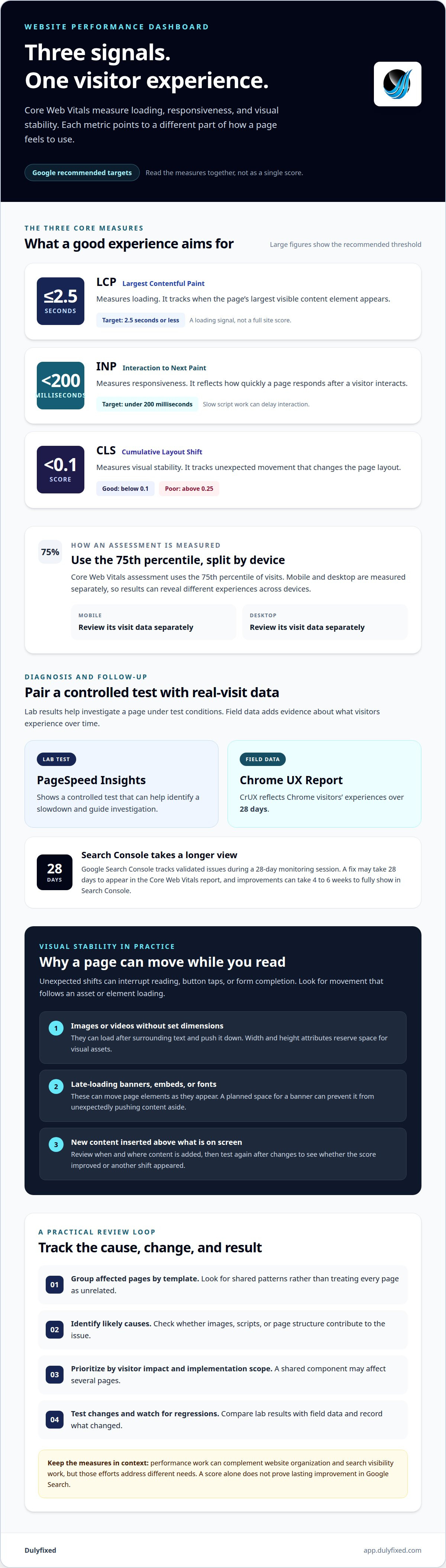
A page can load quickly and still feel unreliable when buttons respond slowly or content jumps as you read. Core Web Vitals measure three parts of the experience: loading, interactivity, and visual stability. Google’s recommended targets are an LCP of 2.5 seconds or less, an INP under 200 milliseconds, and a CLS score below 0.1.
Those measures are useful, but a single improvement won’t keep a site performing well as its content, code, and features change. This guide explains what each metric measures, how layout shifts disrupt a page, and how a website review or scoped maintenance, with scope confirmed per project, may help address issues. You’ll also learn what a professional review can cover and when that support may make sense for a business website in Soap Lake, Ephrata, Moses Lake, Wenatchee, Seattle, Coulee City, Hartline, Wilson Creek, or Marlin.
Key Takeaways
- Learn how loading, responsiveness, and visual stability describe different parts of a visitor’s experience, and why supporting metrics help pinpoint performance issues.
- Understand how unexpected movement can disrupt reading and interaction, and what common layout choices contribute to it.
- See why performance work needs follow-up as website content and features change, and what ongoing review can help uncover.
- Find out when Dulyfixed Small Business Solutions’ website reviews, SEO work, and AI Discovery and Structured Data Optimization can support broader site improvements.
What Are Website Core Web Vitals Metrics?
Core Web Vitals measure real-world loading, interactivity, and visual stability. Google’s good-experience targets are Largest Contentful Paint (LCP) within 2.5 seconds, Interaction to Next Paint (INP) under 200 milliseconds, and Cumulative Layout Shift (CLS) below 0.1. An assessment uses the 75th percentile of visits, measured separately on mobile and desktop.
Diagnosis combines lab tests with field data. PageSpeed Insights can show a controlled test, while Chrome User Experience Report (CrUX) data reflects Chrome visitors’ experiences over 28 days. Comparing the two helps distinguish a lab-only slowdown from an issue affecting real traffic. Agencies and freelancers are easier to compare when they explain both data types, identify affected templates, and tie recommendations to specific metrics.
Supporting metrics can help pinpoint the cause. First Contentful Paint shows when content first appears; Total Blocking Time can indicate JavaScript that delays interaction. A professional can assess whether a performance plugin suits the site by reviewing its features, code dependencies, and interaction with existing plugins, then testing for regressions. Image compression, reduced script work, or simpler page components may address different bottlenecks.
After changes, a professional can compare lab results before and after to check their effect. In the United States, the work required depends on scope, platform, templates, and code complexity. Timelines likewise depend on access, site structure, and the fixes required.
Choose a provider who reports findings, completed changes, and remaining constraints rather than promising rankings or guaranteed scores. For Seattle search visibility, local and national search visibility is a separate aspect from visitor-performance metrics.
Cumulative Layout Shift and visual stability
Cumulative Layout Shift (CLS) tracks unexpected movement that changes a page’s visual layout. A CLS score below 0.1 is considered good, while scores above 0.25 are poor.
Causes of Poor Visual Stability
Images or videos without set dimensions can load after surrounding text and push it down. Late-loading banners, embedded content, and fonts can also move page elements. These shifts disrupt the experience when a visitor tries to read, tap a button, or complete a form. Look for movement that follows an asset or element loading, rather than simply a page that looks uneven.
How a professional prevents Cumulative Layout Shift
Set image and video width and height attributes to reserve space for visual assets. This gives the browser room to render content without rearranging the layout when files load. Page structure matters too: avoid inserting new content above material already on screen. For example, a promotional banner can occupy a planned space instead of appearing unexpectedly between a heading and its text.
How a professional diagnoses and fixes Cumulative Layout Shift
Use PageSpeed Insights and observe actual page behavior to identify which elements move and when. A review can compare affected pages, inspect late-loading assets, and connect a layout shift to its likely cause. Fixes might reserve space, adjust how content loads, or change an element that pushes other content aside. After the changes, test again to see whether the CLS score improved or another shift appeared. This helps keep the page experience consistent, rather than treating one score as proof of lasting improvement in Google Search.
Core Web Vitals maintenance and consultancy
A one-time fix can lose value when a new landing page, tracking script, or site update changes loading behavior. Site owners can include performance checks when planning website changes. Before launch, they can review how new images affect Largest Contentful Paint or whether added JavaScript delays interaction. Afterward, field data can help show whether actual visitors experience the same issue.
Google Search Console tracks validated issues during a 28-day monitoring session. A fix may take 28 days to appear in the Core Web Vitals report, and improvements can take 4-6 weeks to fully show in Search Console. Those delays matter. An immediate lab result can guide action, but it cannot replace the longer view of field data.
Site owners can turn findings into clear decisions by grouping affected pages by template, identifying whether images, scripts, or page structure drive the issue, and prioritizing changes by user impact and implementation scope. If a shared header loads extra JavaScript across several pages, adjusting that component may address a broader problem than changing one page.
Before adding a plugin or changing a working feature, site owners can assess the recommendations against the site’s code, existing tools, and business priorities. After each release, they can compare lab results with Search Console field data, record what changed, and watch for regressions. A consistent review process helps weigh performance work against other site needs and decide which improvements deserve attention first. Any Dulyfixed work related to these tasks would need to be agreed and scoped.
Dulyfixed Small Business Solutions: AI Discovery and Structured Data Optimization
Dulyfixed Small Business Solutions can help when performance improvements need to fit into a broader website or search strategy. Its AI Discovery and Structured Data Optimization work supports clear, organized business information, while AI discovery and structured data optimization addresses how site content is presented for discovery. These efforts complement Core Web Vitals work, but solve different problems.
Consider a website review to identify broader site issues, or a redesign or landing page if the site’s structure needs work. Local and National SEO may fit when search visibility is the priority. The right next step depends on whether the main need is performance, site organization, or discovery.
Make your next website improvement count
Choose the next step based on what visitors need and what your site can support. Performance concerns may be part of a broader website review, while other site goals may call for design updates or search work. Dulyfixed offers website design, redesigns and landing pages, local and national SEO, and AI discovery and structured data optimization. The right priority depends on the issues affecting your website and the business goals you want it to serve. A focused conversation can help connect those needs to a practical plan for a website update.
Get It DulyfixedStart with the change that matters most, then build from there.
Frequently Asked Questions
How can I improve the CWV score on my site?
Start by identifying which page templates and devices show the weakest results, then connect each issue to a likely cause. A product page with oversized images needs a different fix than a contact page delayed by scripts. A professional might prioritize changes by affected pages, visitor tasks, and implementation scope, then retest after updates to check for regressions. These are general examples, not a description of Dulyfixed’s services. Confirm and scope any related Dulyfixed work before proceeding.
How much do Google’s Core Web Vitals impact SEO?
Core Web Vitals contribute to page experience, which Google considers alongside other ranking factors. They do not determine search placement on their own. For a business in Soap Lake, Ephrata, Moses Lake, Wenatchee, Seattle, Coulee City, Hartline, Wilson Creek, or Marlin, prioritize pages that support key customer actions while maintaining relevant, useful content. Treat performance as one part of search visibility, not a substitute for SEO strategy.
What are Core Web Vitals and which metrics are measured?
Core Web Vitals measure real visitor experience across loading, interaction, and visual stability. The metrics are Largest Contentful Paint (LCP), Interaction to Next Paint (INP), and Cumulative Layout Shift (CLS). Together, they show whether the main content appears promptly, the page responds to input, and visible elements stay in place during use.
What are the current Core Web Vitals thresholds for LCP, INP, and CLS?
Google’s good-experience thresholds are LCP within 2.5 seconds, INP under 200 milliseconds, and CLS below 0.1. Assessment uses the 75th percentile of real visits, separated by mobile and desktop. A single lab test can help diagnose a page, but it does not represent every visitor’s device, connection, or browsing conditions.
What does a Core Web Vitals optimization service include?
A Core Web Vitals optimization service might include performance assessment, diagnosis of underlying causes, prioritized recommendations, scoped fixes, and follow-up testing. The exact work depends on the site’s platform, code, and affected pages. A website review might also clarify whether performance issues connect to broader design or maintenance needs before work is planned. These are general examples, not a description of Dulyfixed’s services. Confirm and scope any related Dulyfixed work before proceeding.
Website design and landing pages
Plan pages around the information visitors need and the action they want to take.